
Stress Management Strategies: Clinical Frameworks, Daily Activities, and Recovery Systems
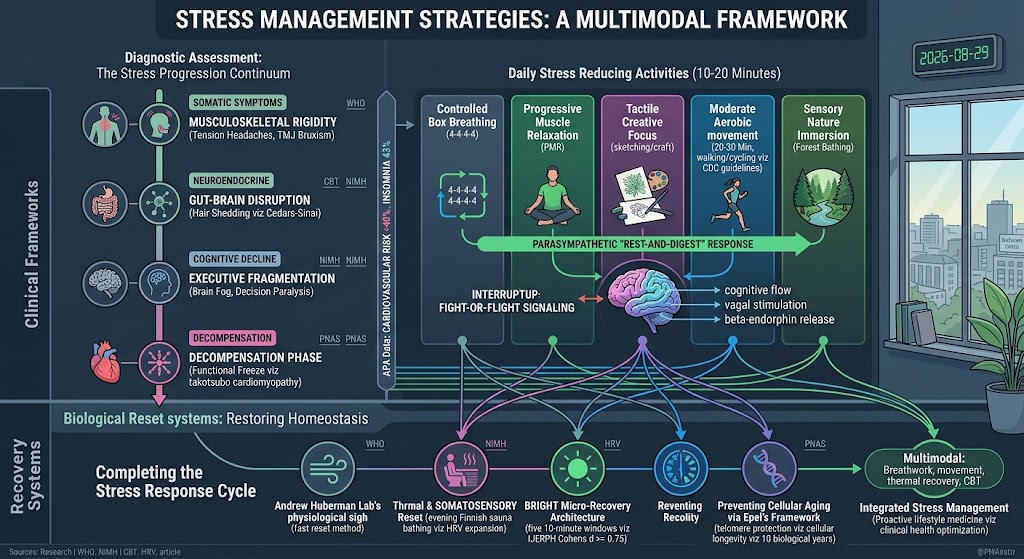
Evidence-based stress management strategies systematically regulate hypothalamic-pituitary-adrenal (HPA) axis activation, prevent allostatic overload, and restore homeostatic autonomic balance. Formally established by the Mayo Clinic and Cleveland Clinic, effective stress intervention integrates clinical diagnostic screening, real-time physiological downregulation, and structured biological recovery protocols to neutralize chronic neuroendocrine exhaustion [1], [2].
Diagnostic Assessment: Clinical Indicators and the Stress Progression Continuum
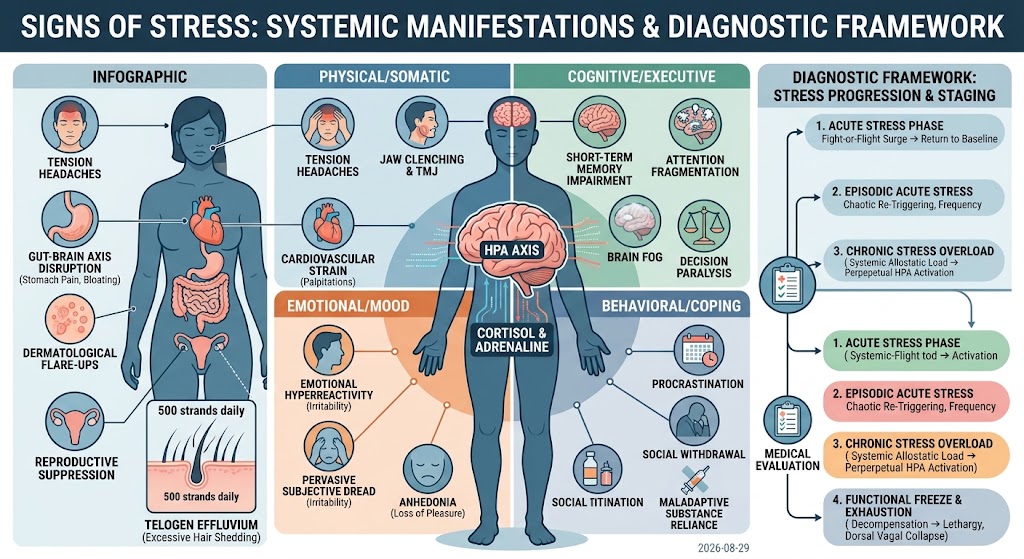
Identifying the biological onset of systemic stress requires tracking multi-system somatic, cognitive, and behavioral alterations before irreversible allostatic damage occurs [3]. Epidemiological data from the American Psychological Association (APA) reveals that unmanaged chronic stress increases cardiovascular disease risk by 40%, with 43% of adults suffering from chronic insomnia and 38% reporting appetite disruption [4]. To review the categorized checklist across physical, cognitive, and emotional domains, explore our clinical diagnostic guide on Signs of Stress.
- Somatic and Musculoskeletal Rigidity: Chronic elevation of cortisol and adrenaline forces skeletal muscles into perpetual contraction, producing tension headaches, trapezius tightness, and temporomandibular joint (TMJ) bruxism [5], [6].
- Neuroendocrine and Gut-Brain Disruption: Cortisol surges alter gastrointestinal blood flow and colonic motility, triggering nausea, chronic inflammation, and telogen effluvium (shedding up to 500 hair follicles daily compared to the 100 baseline according to Cedars-Sinai) [7], [8].
- Executive Cognitive Fragmentation: Glucocorticoid saturation in the prefrontal cortex and hippocampus interferes with working memory consolidation, resulting in operational brain fog and decision paralysis [9], [10].
- The Decompensation Phase (Functional Freeze): When allostatic load exceeds physiological coping capacity, the autonomic nervous system enters dorsal vagal collapse, manifesting as emotional numbness, anhedonia, and elevated risk of Takotsubo cardiomyopathy [11], [12].
Intervention Protocols: Daily Stress Reducing Activities and Somatic Practices
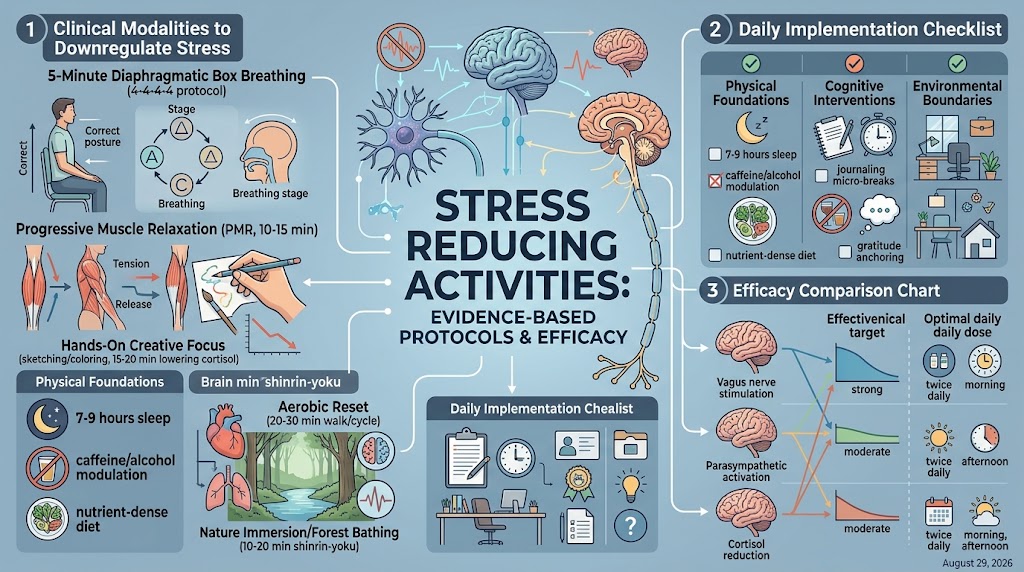
Executing active stress reduction modalities triggers the parasympathetic "rest-and-digest" response, interrupting acute fight-or-flight signaling within 10 to 20 minutes [13]. Large-scale international health studies published in Nature Medicine tracking 93,000 adults across 16 countries confirmed that regular engagement in structured somatic and creative leisure activities significantly reduces depressive symptoms and buffers against biological burnout [14]. Learn the complete step-by-step modalities in our practical guide on Stress Reducing Activities.
- Controlled Resonance and Box Breathing (5 Minutes): Inhale for 4 seconds, hold for 4 seconds, exhale for 4 seconds, and hold empty for 4 seconds to stimulate vagal baroreceptors and rapidly decrease resting heart rate [15], [16].
- Progressive Muscle Relaxation (10 to 15 Minutes): Systematically tense muscle groups at 70% intensity for 5 seconds followed by a 30-second conscious release, disrupting neuromuscular bracing patterns [17].
- Tactile Creative Engagement (15 to 20 Minutes): Engage in non-evaluative sketching, coloring, or craft building; Drexel University neuroimaging data confirms that 15 to 45 minutes of tactile creation significantly lowers salivary cortisol by inducing cognitive flow [18], [19].
- Moderate Aerobic Movement (20 to 30 Minutes): Accumulate 150 minutes of weekly cardiovascular movement (walking, cycling) in alignment with CDC guidelines to stimulate beta-endorphin release and blunt sympathetic reactivity [20], [21].
- Sensory Nature Immersion (10 to 20 Minutes): Practice outdoor green exercise without digital devices; a review of 14 clinical studies confirms that 10 minutes in natural surroundings measurably stabilizes blood pressure and autonomic tone [21], [22].
Biological Reset Systems: Completing the Stress Cycle and Restoring Homeostasis
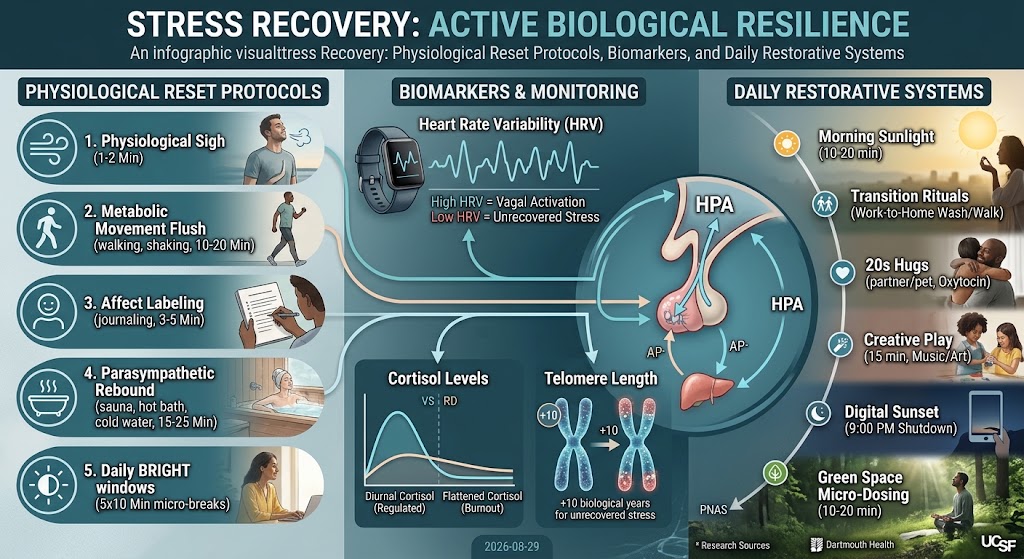
True stress resolution requires active biological recovery that completes the physiological stress response cycle rather than relying on passive sedentary rest [23], [24]. Neuroimaging research published in the Proceedings of the National Academy of Sciences (PNAS) reveals that brain reorganization transitions from alarm mode (Salience Network) to internal restoration (Default Mode Network) over a 60-minute window post-stressor [25]. Review our complete recovery architecture in our dedicated guide on Stress Recovery.
- The 4-Second Physiological Sigh: Execute two sharp nasal inhalations followed by one prolonged oral exhalation; Stanford neuroscientist Andrew Huberman's lab identified this technique as the fastest real-time method to downregulate sympathetic hyperarousal [26].
- Thermal and Somatosensory Reset: Utilize 20 to 30 minutes of evening Finnish sauna bathing (80–90°C) to stimulate heat-shock repair proteins and trigger a long-lasting parasympathetic rebound that expands heart rate variability (HRV) [27].
- The BRIGHT Micro-Recovery Architecture: Schedule five 10-minute recovery windows during non-work hours; randomized controlled trial data published in IJERPH demonstrated that this behavioral protocol produces large effect-size reductions in burnout and chronic tension (Cohen’s d ≥ 0.75) [28].
- Preventing Cellular Aging via Epel's Framework: Landmark UCSF cellular studies by Dr. Elissa Epel established that unmanaged chronic stress shortens protective chromosomal telomeres by the equivalent of 10 biological years, proving that intentional recovery habits are essential for cellular longevity [24].
Strategic Matrix: Acute Stress vs. Chronic Overload vs. Integrated Stress Management
Selecting effective clinical and behavioral interventions requires categorizing the stress presentation across acute reactivity, chronic allostatic overload, and integrated management systems. Research published in BMC Public Health and the Journal of Psychiatric and Mental Health Nursing confirms that while unmanaged chronic overload damages cardiovascular and metabolic networks, structured multimodal interventions restore autonomic equilibrium [29], [14].
| Clinical Parameter | Acute Stress Reactivity | Chronic Allostatic Overload | Integrated Stress Management |
|---|---|---|---|
| Underlying Mechanism | Temporary catecholamine (adrenaline) surge to immediate environmental challenge [2]. | Perpetual HPA axis engagement with flattened, dysregulated diurnal cortisol rhythm [30], [24]. | Timed vagal activation, active stress cycle completion, and neuroendocrine repair [23], [26]. |
| Autonomic Balance | Rapid sympathetic excitation followed by quick spontaneous recovery [5]. | Sympathetic overdrive or dorsal vagal functional freeze collapse [31]. | High Heart Rate Variability (HRV) and balanced autonomic flexibility [31], [27]. |
| Cellular & Organ Impact | Zero long-term organ damage; adaptive for short-term survival [2]. | Accelerated telomere shortening, elevated hs-CRP, and hippocampal atrophy [24]. | Reduced systemic inflammation, normalized blood pressure, and protected cellular aging [24], [29]. |
| Restoration Method | Situational resolution or a brief passive rest interval [5]. | Ineffective with passive rest; requires weeks of structural lifestyle change [24]. | Multimodal: resonance breathwork, movement, thermal recovery, and CBT [28], [32]. |
| Clinical Status | Normal physiological coping mechanism [2]. | Chronic disease risk factor requiring medical intervention [30]. | Proactive lifestyle medicine and clinical health optimization [28], [32]. |
Frequently Asked Questions About Stress Management Strategies
What is the most effective immediate strategy to downregulate acute stress?
The physiological sigh—two deep nasal inhales followed by an extended oral exhale—is the fastest clinically proven technique to downregulate autonomic arousal [26]. Stanford neurobiology research confirms that executing three consecutive sighs immediately engages the vagal brake, reducing arterial pressure and acute sympathetic tone [26].
Why does passive rest fail to resolve chronic stress and fatigue?
Passive rest removes physical labor but fails to provide the active neurochemical and somatosensory cues required to shut down the HPA axis [24], [33]. Studies indicate that prolonged glucocorticoid exposure impairs the hippocampal negative feedback loop, requiring structured somatic movement and respiratory pacing to reset baseline regulation [24], [31].
How much daily exercise is required to achieve measurable stress reduction?
Engaging in 20 to 30 minutes of moderate aerobic activity or accumulating 150 minutes weekly produces significant reductions in perceived stress and cortisol reactivity [20], [21]. Clinical trials demonstrate that even two weekly aerobic sessions significantly decrease anxiety and improve emotional regulation [21].
When should lifestyle stress management be escalated to clinical therapy?
Stress symptoms should be evaluated by a healthcare professional when severe insomnia, unrefreshing sleep, physical panic attacks, or emotional anhedonia persist continuously for more than two weeks [34], [35]. Guidance from the WHO and NIMH emphasizes that persistent symptoms indicate neuroendocrine dysregulation requiring cognitive behavioral therapy (CBT) or diagnostic laboratory evaluation [20], [36].

Related Cluster Articles
Signs of Stress
Clinical symptoms, diagnostic staging frameworks, and multi-system somatic effects of chronic allostatic load.
Stress Reducing Activities
Evidence-based somatic protocols, tactile creative flow, progressive muscle relaxation, and daily self-care checklists.
Stress Recovery
Completing the biological stress response cycle, thermal reset protocols, and biomarker-tracked autonomic recovery.