
Stress Reducing Activities: Evidence-Based Protocols, Daily Practices, and Neurological Interventions
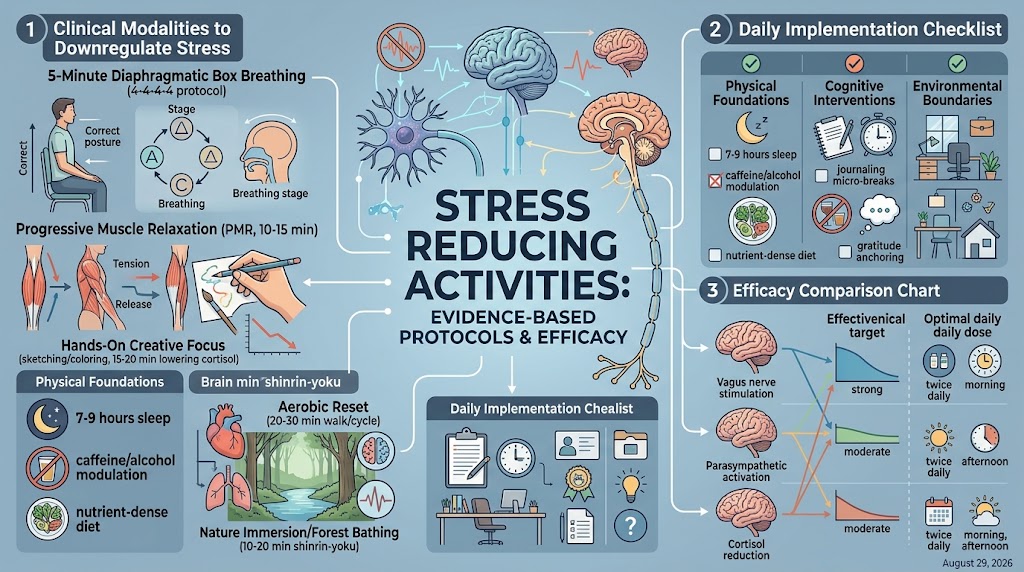
Targeted stress reducing activities systematically downregulate sympathetic nervous system arousal by activating the vagal nerve and lowering serum cortisol concentrations. Clinical data pooled across 93,000 adults in 16 countries confirms that engaging in structured leisure and somatic routines reduces depressive symptoms and buffers against allostatic overload, while clinical trials show that active interventions interrupt fight-or-flight signaling within 10 to 20 minutes [1], [2].
Step-by-Step Execution Guide: Clinical Modalities to Downregulate Stress
Executing stress reduction modalities requires applying specific physiological levers—such as respiratory pacing, somatic tension release, and sensory focusing—to trigger the parasympathetic "rest-and-digest" response [3]. According to Harvard Medical School and the Benson-Henry Institute for Mind Body Medicine, regular application of the relaxation response counteracts adrenaline spikes, reduces resting blood pressure, and improves emotional regulation across high-demand populations [4], [3].
- Deploy Controlled Diaphragmatic or Box Breathing (5 Minutes): Sit upright with one hand on your chest and the other on your abdomen. Practice the 4-4-4-4 box protocol: inhale deeply through the nose for 4 seconds, hold for 4 seconds, exhale smoothly through the mouth for 4 seconds, and hold empty for 4 seconds [4]. This deliberate pacing stimulates the vagus nerve and rapidly slows resting cardiac rhythm [5].
- Perform Progressive Muscle Relaxation (10 to 15 Minutes): Systematically isolate major muscle groups starting from the feet up to the facial muscles. Contract each muscle group with 70% maximum effort for 5 seconds, followed by an immediate 30-second conscious release [6]. This contrast training disrupts somatic bracing and relieves tension headaches and trapezius stiffness [6].
- Engage in Structured Hands-On Creative Focus (15 to 20 Minutes): Utilize low-friction tactile activities such as sketching, adult coloring, or paint-by-numbers. Drexel University neuroimaging and biomarker data indicate that 15 to 45 minutes of non-evaluative art-making significantly reduces circulating cortisol levels by facilitating cognitive flow and dampening rumination [7], [8].
- Execute Moderate-Intensity Aerobic Reset (20 to 30 Minutes): Perform rhythmic movement—such as brisk walking, cycling, or swimming—accumulating toward the Centers for Disease Control and Prevention (CDC) benchmark of 150 minutes per week [9], [10]. A 6-week trial demonstrated that aerobic activity 2 days per week significantly reduces perceived stress and uncertainty intolerance [10].
- Conduct Sensory Grounding in Nature (10 to 20 Minutes): Practice green exercise or Japanese forest bathing (shinrin-yoku) without mobile devices. A meta-review of 14 studies published in medical literature established that as little as 10 minutes spent in a natural setting produces measurable drops in heart rate and perceived psychological strain [10], [11].
Action Plan and Daily Self-Care Implementation Checklist
Sustained stress reduction depends on proactive structural routines rather than reactive crisis management. Polling data from the American Psychological Association (APA) highlights that 46% of adults actively utilize creative and somatic pastimes to manage chronic anxiety, while longitudinal research confirms that consistent non-work hobbies reduce the odds of developing clinical depression by 32% [1].
1. Physical and Biological Foundations
- Sleep Hygiene Window: Secure 7 to 9 hours of uninterrupted nightly sleep by establishing a dark, cool sleeping environment (65°F/18°C) and powering down digital screens 60 minutes before bed [9], [12].
- Stimulant & Alcohol Modulation: Cap daily caffeine consumption below 400 mg (approximately 4 standard cups of coffee), avoid caffeine past 2:00 PM, and restrict alcohol intake to prevent nighttime cortisol spikes [10], [12].
- Nutritional Support: Focus on whole-food nutrient density rich in magnesium, B vitamins, and omega-3 fatty acids while limiting ultra-processed items that exacerbate endocrine instability [10], [13].
2. Cognitive and Expressive Interventions
- Expressive Journaling: Dedicate 10 to 15 minutes to unrestricted expressive writing to untangle mental cognitive loops, externalize suppressed emotions, and downregulate HPA axis reactivity [13], [14].
- Micro-Disconnection Blocks: Implement structured 3- to 6-minute micro-breaks between high-intensity operational tasks to prevent cognitive fatigue and sympathetic saturation [15], [16].
- Gratitude Anchoring: Record 3 concrete positive occurrences daily to foster neuroplastic restructuring away from threat-focused cognitive rumination [17], [9].
3. Environmental and Social Boundary Setting
- Assertion and Workload Capping: Establish firm boundaries by declining non-essential obligations to prevent executive overload and personal resentment [14], [10].
- Proactive Social Engagement: Schedule weekly peer connections or volunteer commitments; Harvard longitudinal data confirms relationship satisfaction is the single strongest predictor of healthy longevity [18], [17].
- Physical Environment De-Cluttering: Maintain an organized physical workspace to minimize extraneous sensory distractions and restore perceived operational control [19], [17].
Efficacy Comparison: Stress Reduction Modalities Across Physiological and Clinical Endpoints
Selecting an effective stress intervention requires matching the specific clinical demand—such as acute somatic panic versus chronic executive burnout—with the corresponding neurological mechanism. Meta-analyses in the Journal of Psychiatric and Mental Health Nursing (pooling 35 RCTs and 3,000+ adults) and Nature Mental Health confirm distinct clinical effect sizes across creative, somatic, and aerobic modalities [1].
| Intervention Modality | Primary Neurological Target | Optimal Daily Dose | Demonstrated Clinical Efficacy | Primary Barrier & Countermeasure |
|---|---|---|---|---|
| Diaphragmatic Breathwork & Meditation | Vagus nerve stimulation; amygdala downregulation [3]. | 5–20 minutes daily [4]. | Lowers systolic blood pressure, slows resting pulse, reduces IBS flare-ups [4], [3]. | Intrusive racing thoughts; use breath counting or anchor sounds [4]. |
| Tactile Arts & Micro-Hobbies | Flow state induction; dopamine reward pathway activation [18], [2]. | 10–45 minutes daily [2], [8]. | Significant anxiety reduction; 32% lower baseline risk of depression [1]. | Blank-page perfectionism; utilize pre-structured templates or kits [1], [7]. |
| Aerobic Exercise & Movement | Endorphin elevation; blunted adrenal sensitivity [20]. | 20–30 minutes daily (150 min/wk) [9]. | Lowers cardiovascular mortality, relieves muscle rigidity, improves sleep [9], [21]. | Fatigue and time scarcity; break sessions into 10-minute micro-bouts [9]. |
| Progressive Muscle Relaxation (PMR) | Somatosensory feedback loop interruption [6]. | 10–15 minutes before sleep [5]. | Reduces chronic myofascial pain, TMJ clenching, and sleep onset latency [6]. | Physical restlessness; practice lying down in a darkened room [5]. |
| Nature Immersion & Forest Bathing | Parasympathetic tone restoration via sensory grounding [11], [22]. | 10–20 minutes in green spaces [10]. | Rapidly stabilizes autonomic tone and reduces salivary cortisol [10], [11]. | Limited rural access; utilize urban parks, arboretums, or indoor plants [10], [5]. |
Frequently Asked Questions About Stress Reducing Activities
How quickly can a stress-reducing activity lower elevated cortisol?
Tactile creative activities and targeted diaphragmatic breathing produce measurable reductions in stress hormones within 10 to 15 minutes [2], [7]. Clinical research from Drexel University and Tufts Medical Center indicates that engaging in structured sensory tasks rapidly interrupts sympathetic tone, shifting brain activity toward parasympathetic recovery [2], [7].
Why are hands-on hobbies often more effective than passive screen rest?
Hands-on hobbies engage motor planning, visual attention, and bilateral coordination, successfully inducing a flow state that crowds out anxious rumination [2], [7]. Passive smartphone scrolling frequently dysregulates the nervous system through constant notification alerts and blue light exposure, increasing baseline stress instead of relieving it [2], [10].
What is the minimum amount of exercise required to reduce daily stress?
Engaging in as little as 20 to 30 minutes of moderate-intensity physical activity or 10 minutes of brisk walking provides significant nervous system relief [21], [9]. The CDC recommends accumulating 150 minutes of aerobic exercise weekly to optimize endorphin release and protect long-term cardiovascular health [9], [10].
When should stress-reducing self-care activities be escalated to professional counseling?
Self-care practices should be escalated to a licensed therapist or physician when stress symptoms persist continuously, impair basic daily routines, or trigger debilitating panic [14], [9]. The National Institute of Mental Health and Mayo Clinic emphasize that while lifestyle activities maintain mental hygiene, clinical disorders require targeted interventions like cognitive behavioral therapy (CBT) [9], [14].