
Emotional Intelligence (EQ): Psychological Frameworks, Core Skills, and Execution Systems
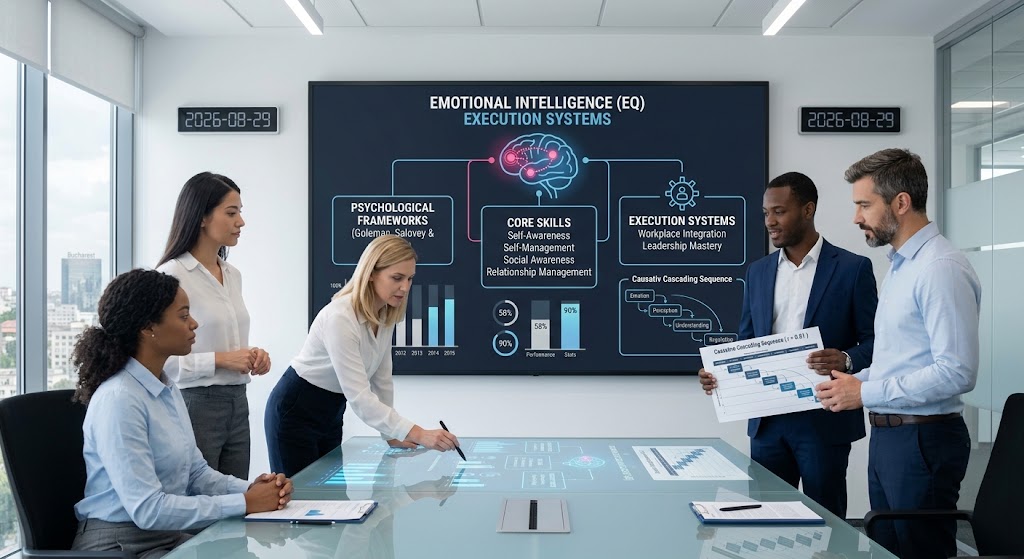
Emotional intelligence (EQ) is the capacity to perceive, evaluate, regulate, and strategically leverage affective signals to guide cognition and interpersonal behavior. Grounded in foundational models by Salovey, Mayer, and Goleman, developing emotional knowledge strengthens prefrontal-amygdala neural circuitry, accounting for up to 58% of professional performance variance and predicting 90% of executive leadership differentiation [1], [2].
Core Dimensions and Theoretical Models of Emotional Intelligence
Emotional intelligence operates across two primary scientific paradigms: the four-branch cognitive ability model and the four-domain behavioral competence framework [3], [4]. Research in the Journal of Applied Psychology by Joseph and Newman confirms a causal cascading sequence where Emotion Perception directly enables Emotion Understanding, which subsequently dictates conscious Emotion Regulation [3]. To master the practical drills that automate these cognitive branches, review our complete clinical protocol on Emotional Intelligence Exercises.
- Self-Awareness & Emotion Perception: The foundational ability to accurately identify internal affective states and physical somatic cues in real time [5]. While 95% of individuals believe they possess high self-awareness, psychometric investigations by Dr. Tasha Eurich published in the Harvard Business Review reveal that only 10% to 15% meet empirical criteria [6].
- Self-Management & Cognitive Regulation: The capacity to redirect disruptive impulses, manage stress reactivity, and maintain composed decision-making under crisis [7]. A 2026 randomized controlled trial in Nature Scientific Reports proved that structured emotional regulation training nearly doubles cognitive decision accuracy under acute stress (94.1% vs. 51.6%) [8].
- Social Awareness & Cognitive Empathy: The skill of accurately decoding non-verbal cues, micro-expressions, and unstated organizational dynamics [9]. Global leadership analytics by DDI show that managers demonstrating high empathy achieve 40% higher performance across team engagement, talent coaching, and cross-functional planning [6].
- Relationship Management & Influence: The integration of social skills to navigate complex negotiations, resolve workplace disputes, and inspire team followership [2]. Statistical analyses in the International Journal of Technology and Emerging Research establish that relationship management represents the single strongest quantitative predictor of executive efficacy (r = 0.81) [10].
Workplace Integration: Operationalizing EQ Across Teams and Systems
Scaling emotional intelligence across organizational workflows transforms interpersonal friction into collaborative execution and high psychological safety [11]. A 30-year psychometric meta-analysis in Frontiers in Psychology established that enterprise-wide EQ directly drives organizational citizenship behavior, employee retention, and overall company profitability [12]. For actionable team blueprints and HR alignment models, review our strategic playbook on Emotional Intelligence in the Workplace.
- Deploy Objective 360-Degree Behavioral Benchmarks: Establish organizational baselines using validated instruments such as the Mayer-Salovey-Caruso Emotional Intelligence Test (MSCEIT) or multi-rater reviews to eliminate managerial blind spots [13], [6]. Data indicates that 71% of top employers prioritize emotional competencies over technical proficiency during candidate evaluations [6].
- Institute Structured Communication and Feedback Loops: Replace unstructured criticism with behavior-impact feedback models that separate operational challenges from personal identity [14]. Research from SHRM confirms that unaddressed interpersonal friction drains eight hours of productive company time per incident in disengagement and rumor escalation [6].
- Align Talent Frameworks with the Yale AMO Architecture: Structure organizational policies around the Ability-Motivation-Opportunity (AMO) model from the Yale Center for Emotional Intelligence, ensuring personnel possess the skills, incentives, and cultural freedom to express emotional knowledge [15].
- Enforce Cognitive Boundary Architecture: Protect employee cognitive bandwidth by implementing strict digital communication curfews and batching asynchronous messages [16]. Longitudinal workplace studies show that work-contextualized EQ protects professionals against work-to-family cognitive spillover and burnout [16].
Leadership Mastery: Executive Frameworks for High-Trust Teams
Mastering emotional intelligence in executive leadership serves as the primary mechanism separating transformational leaders from authoritarian managers [17]. A 2026 PRISMA meta-analysis in Administrative Sciences across 728 empirical studies confirmed a strong, positive correlation between leader emotional intelligence and transformational leadership (r ≈ 0.63) as well as team effectiveness (r ≈ 0.41) [17]. To implement boardroom mediation protocols and coaching architectures, consult our executive guide on Emotional Intelligence in Leadership.
- The 90/10 Self-Regulation Pause Under Crisis: When confronted with organizational disruption, executives pause for 10 seconds of diaphragmatic breathing before issuing directives [18]. Leaders practicing structured somatic self-regulation demonstrate 23% higher decision-making quality and 18% greater crisis composure [10].
- Subordinate Burnout Buffering: Multilevel modeling published in Cogent Psychology shows that a supervisor's emotion perception accuracy directly reduces follower emotional exhaustion while increasing team cohesion [19].
- Psychological Safety Modeling: Great Place to Work analytics confirm that organizations led by high-trust, emotionally intelligent managers maintain 50% lower employee turnover and achieve 2x to 3x higher long-term market performance [20].
- Conflict Depersonalization: Resolving high-stakes boardroom disputes by shifting the conversation from positional confrontation to shared strategic outcomes resolves organizational friction 45% to 53% faster [10], [21].
Comparative Matrix: Cognitive IQ vs. Trait EQ vs. Ability Emotional Intelligence
Distinguishing between general cognitive intelligence (IQ), self-reported trait emotional intelligence, and objective ability emotional intelligence is essential to design valid training curricula and assessment protocols. Psychometric reviews in Behavioral Sciences prove that ability-based emotional intelligence tests (like MSCEIT) evaluate actual neurological processing capacity, whereas trait inventories capture personality self-perceptions [22], [4].
| Psychometric Dimension | Cognitive Intelligence (IQ) | Trait Emotional Intelligence | Ability Emotional Intelligence |
|---|---|---|---|
| Core Construct | Abstract problem-solving, spatial reasoning, and working memory [4]. | Self-perceived behavioral dispositions and emotional confidence [22]. | Actual cognitive capacity to process and regulate affective data [3], [8]. |
| Primary Measurement Tool | Standardized cognitive psychometrics (WAIS, Raven's Matrices) [4]. | Self-report inventories (TEIQue, EQ-i 2.0, Goleman Scales) [13]. | Performance-based maximum-ability testing (MSCEIT) [13], [6]. |
| Neurobiological Substrate | Dorsolateral prefrontal cortex and parietal networks [5]. | Anterior cingulate cortex and personality-linked mood networks [23]. | Ventrolateral prefrontal cortex (vlPFC) and amygdala feedback loops [24]. |
| Trainability & Plasticity | Relatively static in healthy adults following cognitive maturation [4]. | Moderately plastic through habit restructuring and self-reflection [5]. | Highly trainable through deliberate cognitive and somatic exercises [23], [8]. |
| Workplace Predictive Value | Predicts technical learning speed and entry-level task execution [6]. | Predicts subjective job satisfaction and self-rated leadership confidence [22]. | Predicts 58% of job performance and 90% of executive success [25], [2]. |
Frequently Asked Questions About Emotional Intelligence
What is the scientific definition of emotional intelligence (EQ)?
Emotional intelligence is the ability to perceive, understand, integrate, and regulate emotional information to guide thought and behavior [1], [3]. Established by Salovey and Mayer, the construct describes measurable cognitive operations that process affective stimuli rather than static personality traits [3], [4].
How do emotional intelligence skills directly improve leadership performance?
Emotional intelligence enables executives to regulate personal stress, construct psychological safety, and de-escalate organizational conflict [6], [10]. A 2026 meta-analysis in Administrative Sciences confirmed a strong correlation between leader EQ and transformational leadership (r ≈ 0.63), resulting in 40% to 50% lower employee turnover [17], [20].
Can emotional intelligence skills be learned and trained in adulthood?
Yes, emotional intelligence is highly trainable in adulthood through deliberate cognitive reframing, affect labeling, and perspective-taking exercises [23], [7]. Controlled neuroplasticity studies show that consistent 5-minute daily practices automate new prefrontal regulatory pathways within 66 days [7], [8].
What is the measured business ROI of developing emotional intelligence in the workplace?
Workplace emotional intelligence programs deliver a documented financial return of 150% to 300% on investment by slashing turnover and boosting collaboration [11]. Corporate analytics confirm that high-EQ divisions achieve 23% higher profitability and outperform operational targets by 20% compared to low-EQ peers [11], [26].

Related Cluster Articles
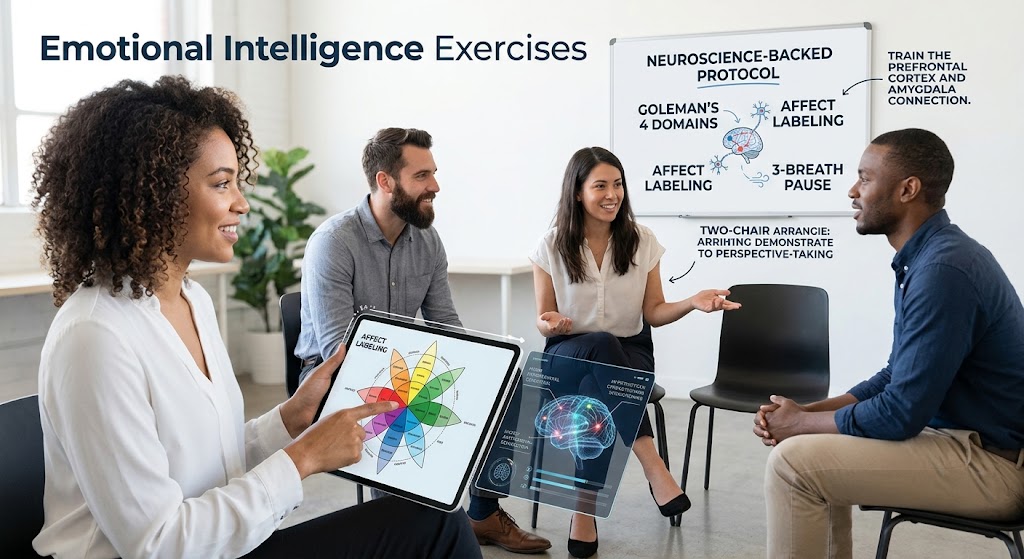
Emotional Intelligence Exercises
A 5-step neuroscience-backed training protocol utilizing affect labeling, DBT techniques, and perspective mapping.
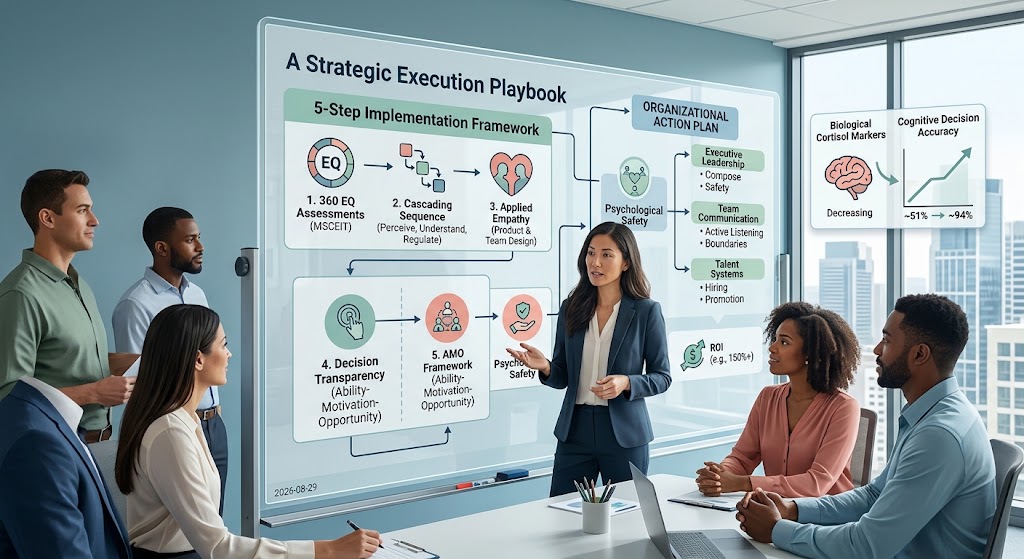
EQ in the Workplace
A strategic organizational execution playbook covering the cascading ability model and the Yale AMO architecture.
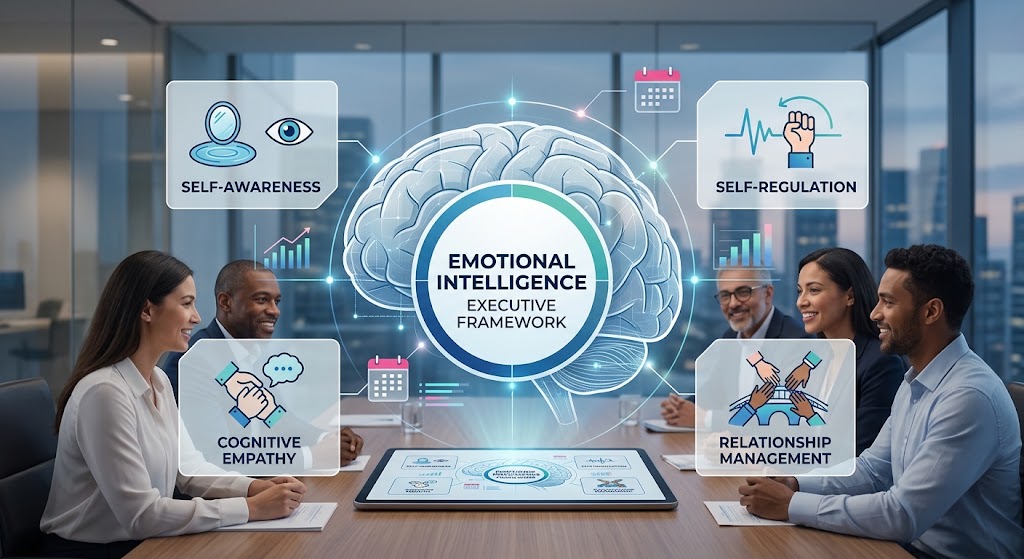
EQ in Leadership
The executive leadership framework for crisis composure, transformational coaching, and psychological safety.