
Emotional Intelligence Exercises: A Neuroscience-Backed Training Protocol
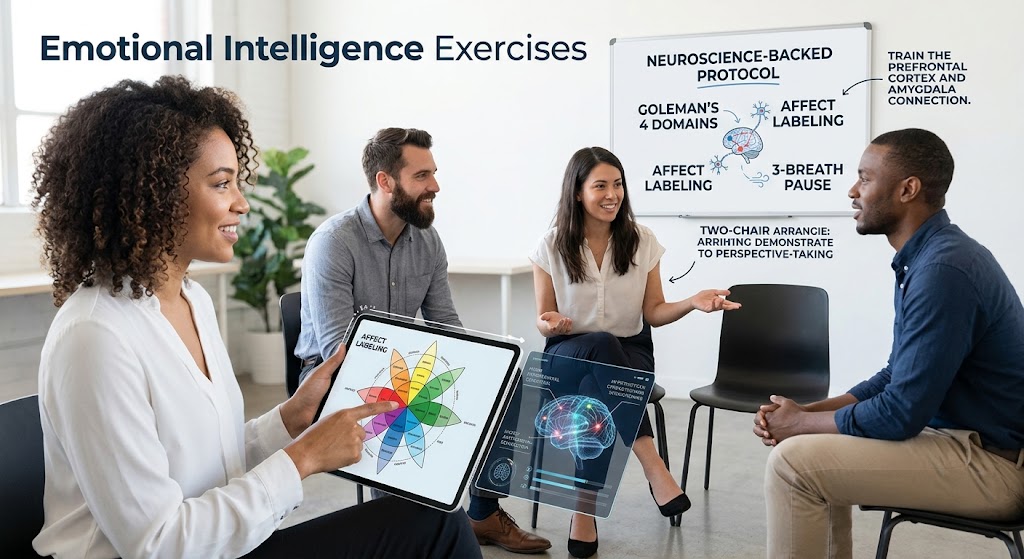
Building emotional intelligence requires practicing structured neuro-cognitive routines that train affect labeling, cognitive reframing, perspective-taking, and empathic communication. Grounded in research from Yale and UCLA, targeted emotional intelligence exercises strengthen connections between the prefrontal cortex and amygdala, driving measurable improvements in emotional regulation, professional leadership, and interpersonal relationships [1], [2].
5 Core Exercises for Building Emotional Intelligence
Developing emotional intelligence depends on deliberate cognitive practice rather than static personality traits [3]. A meta-analysis published in Emotion Review analyzing 24 controlled training studies demonstrated that structured emotional intelligence interventions produce moderate-to-large improvements in emotional competence that persist for months post-training [2]. Furthermore, empirical workplace evaluations cited by Masterplan reveal that emotional intelligence predicts 58% of job performance across professional categories, making daily exercises a critical driver of career success [4].
- Deploy Daily Affect Labeling (Self-Awareness): Pause three times daily to identify exact emotions using Robert Plutchik’s wheel or Marc Brackett’s RULER framework rather than defaulting to broad terms like "fine" or "stressed" [1], [5]. In landmark fMRI research at UCLA, Matthew Lieberman proved that putting specific words to an emotional state directly dampens amygdala reactivity while activating the right ventrolateral prefrontal cortex, achieving immediate neural regulation [6], [2].
- Execute the Metacognitive "Three-Breath Pause" (Self-Regulation): When encountering an emotionally triggering stimulus, inhale slowly for 4 seconds and exhale for 8 seconds over three consecutive breaths before formulating a verbal or digital response [5], [2]. Research from the University of Sydney by Riley Leckie and colleagues confirms that metacognitive monitoring—evaluating response confidence and pausing—substantially improves real-time emotion management and prevents impulsive reactivity [7].
- Run the "Two-Chair" Perspective Journal (Empathy): Record a tense interaction on paper by documenting the objective facts, followed by your internal emotional experience ("Your Chair"), and then writing an account from the other person's perspective ("Their Chair") [8]. Northwestern University studies on cognitive overlap reveal that simulating another person’s mental state significantly enhances empathic accuracy and neutralizes adversarial assumptions in professional negotiations [2].
- Implement Cognitive Defusion and the STOP Technique (Impulse Control): When overwhelmed by automatic negative cognitions, apply Marsha Linehan’s Dialectical Behavior Therapy (DBT) protocol: Stop moving, Take a breath, Observe thoughts as external phenomena, and Proceed with values-aligned action [5], [9]. Clinical trials by Steven Hayes demonstrate that reframing thoughts using defusion formulas (e.g., "I notice I am having the thought that...") strips destructive narratives of their emotional charge without suppressing the feeling [5].
- Conduct 5-Minute Reciprocal Active Listening Drills (Relationship Management): Practice structured communication in pairs where one partner speaks for three minutes while the listener maintains eye contact, suppresses interruptions, and paraphrases the core emotional message before responding [10], [11]. Research by John Gottman shows that active emotional attunement and "turning toward" relational bids represents the single most accurate predictor of long-term relational stability and collaborative team cohesion [5].
Categorized EQ Action Plan Across the 4 Goleman Domains
Structuring emotional intelligence training across Daniel Goleman's four core competency domains ensures comprehensive psychological development. Organizational studies by Dr. Tasha Eurich published in the Harvard Business Review found that while 95% of individuals believe they possess high self-awareness, only 10% to 15% meet empirical benchmarks, highlighting the necessity of structured, objective routines [3], [1].
1. Self-Awareness Exercises
- Interoceptive Somatic Scanning: Spend three minutes every morning scanning physical sensations (jaw tension, chest constriction, stomach knots) to identify emotional signatures before conscious awareness takes hold [5], [12].
- The STPA Reflection Journal: Record stressful encounters daily by logging Situation (facts only), Thoughts (internal monologue), Physiology (bodily markers), and Actions taken to identify recurring emotional triggers [5], [13].
- 360-Degree Feedback Auditing: Solicit anonymous evaluations from colleagues and family members regarding how you handle pressure and conflict to close the gap between internal intent and external impact [3], [4].
2. Self-Management Exercises
- Cognitive Reappraisal Drills: Transform rigid demands into growth perspectives by systematically generating three alternative explanations for ambiguous or frustrating events [1], [2]; Stanford research by James Gross confirms habitual reappraisal significantly reduces depressive symptoms [2].
- The "Fogging" Technique: Disarm aggressive criticism by calmly agreeing with the factual part of an opponent's statement without escalating emotional defensiveness [11].
- Mindful Somatic Grounding: Execute the 5-4-3-2-1 sensory countdown during high-stress operational moments to interrupt sympathetic fight-or-flight cascades [14].
3. Social Awareness Exercises
- Micro-Expression & Body Language Tracking: Spend 10 minutes weekly engaging in structured people-watching to practice decoding subtle non-verbal cues such as gaze aversion, breathing shifts, and postural changes [15], [16].
- Empathy Mapping Sessions: Map team stakeholder challenges across four explicit quadrants—"Says," "Thinks," "Does," and "Feels"—to uncover hidden emotional drivers and unstated needs [10], [17].
- Affective Storytelling Inquiries: Utilize open-ended "back-pocket" questions (e.g., "What part of this project feels most demanding for you?") to invite deeper emotional transparency [15].
4. Relationship Management Exercises
- Collaborative Conflict Framing: Open difficult workplace negotiations by establishing shared common ground before addressing points of friction, using structured de-escalation role-plays [15], [18].
- Decision Transparency Explanations: Proactively explain the "why" and trade-offs behind operational decisions to build organizational trust and prevent team cynicism [15], [11].
- Relational Check-In Rituals: Begin team meetings with a 60-second emotional check-in where participants share a one-word descriptor of their current capacity, establishing psychological safety [17], [6].
Intervention Matrix: Comparing Emotional Intelligence Exercises by Mechanism and Efficacy
Selecting appropriate emotional intelligence exercises requires matching the specific cognitive or behavioral routine to the desired psychological domain and neural mechanism. Research synthesized in PositivePsychology demonstrates that multi-tiered exercises targeting individual and group-level dynamics yield the most sustainable improvements in team efficacy and leadership performance [11].
| Exercise Protocol | Target EQ Domain | Neurological Mechanism | Recommended Cadence | Demonstrated Outcome |
|---|---|---|---|---|
| Affect Labeling & Mood Meter (Lieberman / Brackett Protocol) | Self-Awareness [1] | Downregulates amygdala arousal; activates right ventrolateral prefrontal cortex (rvlPFC) [2]. | 3x Daily (60 Seconds) | Immediate reduction in subjective distress and increased emotional granularity [6]. |
| DBT STOP & 4-7-8 Breathing (Linehan / Weil Framework) | Self-Management [5] | Stimulates the vagus nerve, engaging parasympathetic "rest-and-digest" dominance [5]. | As needed during acute stress | Interrupts automatic emotional escalation and lowers cortisol reactivity [5]. |
| Two-Chair Perspective Journal (Salovey & Mayer / Galinsky) | Social Awareness (Empathy) [8] | Engages default mode network (DMN) and medial prefrontal cortex for mentalization [5]. | 1–2x Weekly after conflicts | Reduces cognitive bias, improves empathic accuracy, and clarifies mutual goals [2], [8]. |
| Structured Active Listening (Gottman / Rogers Method) | Relationship Management [5] | Fosters neural synchrony, emotional resonance, and oxytocin release [18]. | Daily in 5-minute interactions | Eliminates conversational misunderstandings and builds high team psychological safety [17]. |
| Cognitive Reappraisal (STPA) (Beck / Gross Model) | Self-Regulation & Metacognition [1] | Strengthens executive control networks over anterior insula threat detection [2]. | 3x Weekly (Evening Review) | Decouples triggers from impulsive reactions and lowers long-term depressive risk [2]. |
Frequently Asked Questions About Emotional Intelligence Exercises
How quickly can you increase emotional intelligence with daily exercises?
Measurable improvements in emotional regulation and attention control appear within 4 to 8 weeks of consistent daily exercise practice [2], [5]. Clinical research on neuroplasticity indicates that repeating daily 5-minute routines automates new neural pathways in approximately 66 days, creating permanent behavioral shifts [5].
Why does naming specific emotions improve emotional self-regulation?
Affect labeling immediately shifts neural processing from the reactive amygdala to the rational prefrontal cortex [2], [6]. Neuroimaging studies by Matthew Lieberman demonstrate that identifying feelings with granular precision acts as an implicit regulation mechanism, reducing physiological threat responses without requiring suppression [6].
What is the difference between emotional intelligence and cognitive IQ?
Cognitive IQ measures static problem-solving and logical reasoning abilities, whereas emotional intelligence (EQ) measures trainable psychological competencies in perceiving, managing, and navigating emotions [3], [2]. While IQ remains relatively fixed in adulthood, EQ is highly plastic and can be continuously enhanced across the lifespan through deliberate training [1], [4].
How do active listening exercises improve workplace leadership?
Active listening exercises enhance managerial empathy, prevent cognitive misinterpretations, and foster psychological safety across teams [10], [17]. Research shows that 75% of HR executives factor emotional intelligence into promotion decisions because leaders who practice active attunement achieve higher employee retention and conflict resolution speed [4], [17].