
Emotional Intelligence in Leadership: The Executive Framework for High-Performing Teams
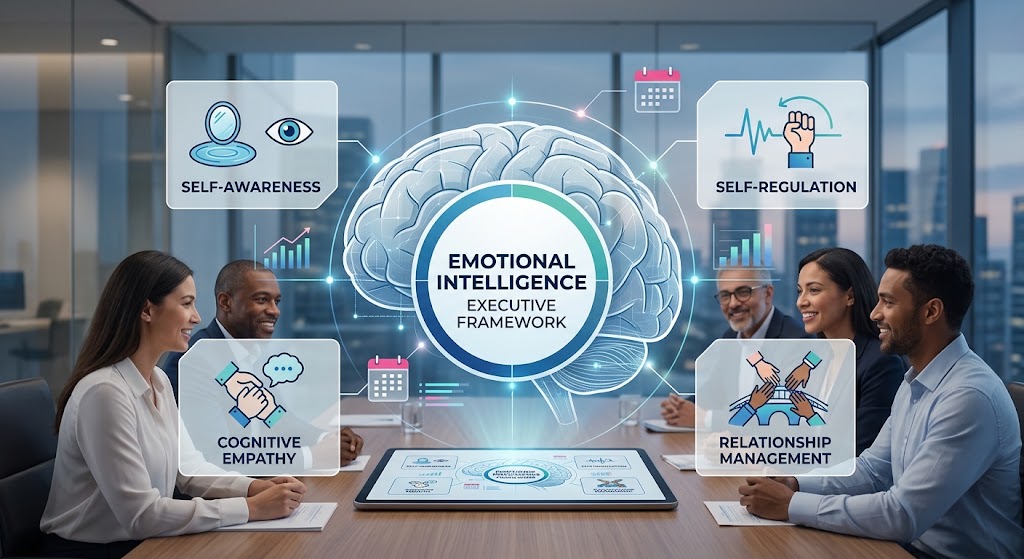
Mastering emotional intelligence in leadership requires developing self-awareness, active emotional self-regulation, cognitive empathy, and constructive relationship management. Synthesizing research across 101 empirical studies in Human Resource Development Review, emotional intelligence and leadership capabilities account for up to 90% of executive success, directly driving employee retention, psychological safety, and organizational performance [1], [2].
5-Step Protocol for Developing Emotional Intelligence in Leadership
Executing an emotionally intelligent leadership model requires systematic behavioral practices that translate personal emotional regulation into organizational trust and high team performance [3]. A 2026 correlational meta-analysis published in Administrative Sciences across 728 empirical studies confirmed a strong, positive correlation between leader emotional intelligence and transformational leadership (r ≈ 0.63) as well as team effectiveness (r ≈ 0.41), proving that socioemotional mastery is a quantifiable leadership asset [4].
- Conduct 360-Degree Self-Awareness Audits: Compare personal leadership self-assessments against anonymous feedback from direct reports, peers, and executive boards to identify blind spots in communication and stress responses [2], [5]. Research from Harvard Business School Online highlights that while 95% of leaders believe they are self-aware, only 10% to 15% meet objective benchmarks, making multi-rater 360-degree reviews an indispensable developmental prerequisite [2].
- Implement the 90/10 Self-Regulation Pause Under Crisis: When confronted with sudden operational disruptions or high-stakes pressure, pause and apply controlled diaphragmatic breathing for 10 seconds before issuing directives [6], [7]. Empirical data published in the International Journal of Technology and Emerging Research shows that leaders with high self-regulation scores achieve 23% higher decision-making quality and 18% greater stress management capability during organizational crises [8].
- Operationalize Cognitive Empathy in Daily Decision-Making: Separate personal projection from genuine perspective-taking by systematically exploring why direct reports or cross-functional stakeholders hold dissenting viewpoints [5], [9]. Global leadership analytics by DDI rank empathy as the primary leadership competency, showing that empathetic leaders achieve 40% higher performance in coaching, team engagement, and strategic planning [2].
- Adopt Transformational Leadership Coaching Behaviors: Replace transactional oversight with individualized consideration, clear mission articulation, and psychological safety [4], [10]. A multilevel study published in Cogent Psychology established that a supervisor's emotion management and perception accuracy directly reduce subordinate emotional burnout while boosting perceived group cohesion and workplace satisfaction [11].
- Establish Systematic Team Psychological Safety Check-Ins: Schedule recurring team check-ins to evaluate workload sustainability, solicit unfiltered bottom-up feedback, and address emerging interpersonal friction before it escalates [7], [12]. Workplace analytics by Great Place to Work demonstrate that organizations led by high-trust, emotionally intelligent managers maintain 50% lower employee turnover and achieve 2x to 3x higher long-term market performance [7].
Executive Action Checklist for Emotionally Intelligent Leadership
Translating emotional intelligence into executive capability requires targeted practices spanning crisis composure, team coaching, conflict resolution, and boardroom diplomacy. Supervised machine learning research published in Behavioral Sciences revealed that trait emotional intelligence significantly outperforms cognitive ability (IQ) in predicting formal managerial status and leadership emergence [13].
1. Crisis Management & Self-Regulation
- Affective Impulse Filtering: Refrain from sending immediate digital communications during heated disagreements; draft responses offline and review after 24 hours to prevent destructive escalation [3], [9].
- Values-Based Decision Anchoring: Align high-pressure corporate choices with core organizational values rather than short-term panic, maintaining team stability [3], [14].
- Vulnerability and Accountability Modeling: Openly acknowledge managerial missteps and take public responsibility, signaling psychological safety across the enterprise [15], [9].
2. Empathetic Team Coaching & Followership
- Uninterrupted Active Listening: Practice listening without mentally assembling a rebuttal, observing vocal tone, posture, and facial micro-expressions during 1-on-1 meetings [5], [15].
- Contextual Needs Diagnosis: Differentiate between technical capability blockers and underlying emotional stress or burnout in underperforming direct reports [16], [7].
- Tailored Motivation Delivery: Align project assignments with individual career aspirations and intrinsic drivers rather than relying exclusively on compensation incentives [3], [17].
3. Strategic Conflict Mediation & Boardroom Dynamics
- Objective Framing Separation: Depersonalize boardroom disputes by shifting the dialogue from "who is right" to "what outcome best serves organizational strategy" [9], [17].
- Relationship Management Prioritization: Invest time in building lateral trust across cross-functional department heads, recognizing relationship management as the strongest statistical predictor of leadership success (r = 0.81) [8].
- Inclusive Leadership Navigation: Integrate emotional awareness with cultural intelligence (CQ) to lead diverse global teams effectively and eliminate systemic workplace bias [18], [19].
Leadership Matrix: Authoritarian Management vs. Emotionally Intelligent Leadership
Comparing authoritarian management models against emotionally intelligent leadership frameworks demonstrates clear divergences in employee turnover, problem-solving agility, and overall team performance. Longitudinal research in the Leadership & Organization Development Journal confirms that transformational leadership fully mediates the relationship between managerial emotional intelligence and employee job satisfaction [20].
| Leadership Dimension | Authoritarian / Low-EQ Management | Emotionally Intelligent Leadership | Empirical Evidence & Impact |
|---|---|---|---|
| Decision-Making Style | Autocratic, purely analytical, ignoring human impact and team morale [16], [9]. | Balanced; integrates empirical data with emotional and social implications [7]. | 23% higher decision quality under stress [8]. |
| Conflict Resolution | Avoidance, mandate enforcement, or aggressive personal confrontation [21]. | Mediation-focused; addresses underlying concerns while separating facts from emotion [7], [17]. | Resolves workplace disputes 45%–53% faster [8]. |
| Employee Engagement | Transactional compliance driven by fear, micromanagement, or quotas [21], [10]. | Transformational empowerment through shared purpose and empathy [4], [15]. | 34% to 76% increase in workforce engagement [8], [3]. |
| Retention & Burnout | High turnover, absenteeism, and widespread subordinate emotional exhaustion [1], [11]. | Buffers stress, protects psychological safety, and supports career longevity [19], [12]. | 40% to 50% lower employee turnover rates [7], [8]. |
| Leadership Effectiveness | Narrowly reliant on technical expertise and positional authority [16], [5]. | Broad influence, high relationship management, and followership inspiration [8], [4]. | Strong overall effectiveness correlation (r = 0.78) [8]. |
Frequently Asked Questions About Emotional Intelligence in Leadership
Why is emotional intelligence in leadership more predictive of success than IQ?
Cognitive intelligence (IQ) and technical knowledge establish baseline competence for executive roles, but emotional intelligence dictates a leader's ability to influence, motivate, and coordinate teams under pressure [16], [2]. Research across 200 global corporations published by Daniel Goleman revealed that emotional competencies account for nearly 90% of the performance differentiation among top-tier executives [3], [6].
How does a leader's emotional intelligence affect team burnout and stress?
Supervisors with high emotion perception and management skills buffer their teams against chronic workplace stress by fostering psychological safety and redistributing unmanageable demands [11], [19]. Multilevel modeling in Cogent Psychology demonstrated that leaders who accurately decode subordinate emotional distress significantly reduce team burnout and increase group cohesion [11].
What is the correlation between emotional intelligence and transformational leadership?
Empirical research demonstrates a strong, statistically significant correlation of r ≈ 0.63 between emotional intelligence and transformational leadership [4]. A 2026 PRISMA meta-analysis in Administrative Sciences confirmed that emotional intelligence serves as the foundational socioemotional mechanism enabling transformational behaviors such as inspirational motivation and individualized consideration [4].
How can executives assess and improve their emotional intelligence?
Executives improve their emotional intelligence by pairing structured 360-degree feedback assessments with deliberate reflection, active listening practice, and behavioral coaching [2], [1]. Controlled training trials demonstrate that leaders undergoing structured EQ programs achieve a 42% increase in subordinate retention and a 53% improvement in conflict resolution effectiveness within 12 months [8].