
Emotional Intelligence in the Workplace: A Strategic Execution Playbook
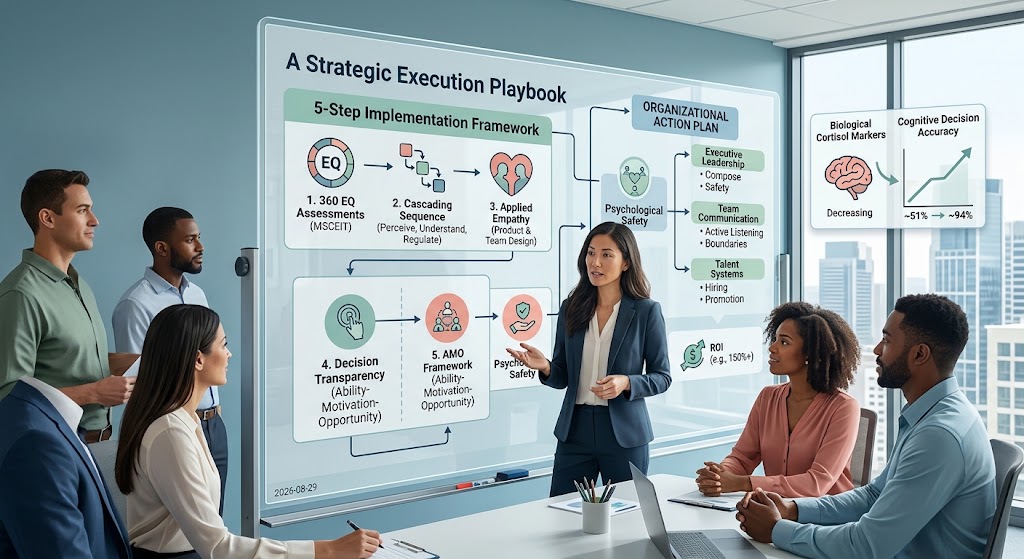
Developing emotional intelligence in the workplace requires embedding validated behavioral assessments, structured communication loops, and real-time self-regulation protocols across organizational systems. Backed by research from Harvard, Yale, and the World Economic Forum, emotional intelligence at work accounts for 58% of professional performance variance, directly enhancing team psychological safety, decision-making quality, and cross-functional execution [1], [2].
5-Step Implementation Framework for Workplace Emotional Intelligence
Systematically upgrading emotional intelligence in the workplace requires structural integration into leadership development and daily operating rhythms rather than one-off workshops [3]. A 2026 randomized controlled trial published in Nature Scientific Reports proved that structured, ability-based emotional intelligence training significantly lowers biological cortisol markers and nearly doubles cognitive decision accuracy under high-stress conditions (94.1% vs. 51.6%), confirming that emotional competencies are highly trainable operational drivers [4].
- Deploy Validated 360-Degree Behavioral Benchmarks: Measure organizational EQ baselines using standardized tools like the Mayer-Salovey-Caruso Emotional Intelligence Test (MSCEIT) or 360-degree behavioral assessments to identify self-awareness blind spots [2], [5]. Research led by Dr. Tasha Eurich published in the Harvard Business Review highlights that while 95% of professionals believe they are self-aware, only 10% to 15% meet empirical criteria, creating severe operational friction when unaddressed [5].
- Institutionalize the Cascading Ability Sequence: Train managers using the sequential ability model formulated by Dana Joseph and Daniel Newman in the Journal of Applied Psychology: Emotion Perception causally precedes Emotion Understanding, which subsequently dictates conscious Emotion Regulation [6]. Meta-analyses in the Journal of Organizational Behavior confirm that mastering this cognitive sequence yields corrected performance correlations up to 0.30, particularly in high-emotional-labor environments [7].
- Embed Applied Empathy into Product & Team Design: Operationalize empathy as an innovation tool to decode unarticulated stakeholder and client needs rather than treating it as an ambiguous soft skill [8]. Microsoft CEO Satya Nadella emphasizes that applied empathy forms the core engine of business innovation, while leadership analytics from DDI show that managers excelling in empathy achieve 40% higher performance in coaching and engagement [8], [5].
- Establish De-escalation and Decision-Transparency Protocols: Require leaders to articulate the objective rationale behind difficult strategic decisions to eliminate workplace cynicism and prevent emotional toxicity [9], [10]. Data from the Society for Human Resource Management (SHRM) reveals that unaddressed workplace conflicts drain an average of eight hours of productive company time per incident in gossip and disengagement [5].
- Align Human Resource Systems with the AMO Framework: Reconfigure HR policies around the Ability-Motivation-Opportunity (AMO) model pioneered by the Yale Center for Emotional Intelligence, ensuring employees possess the skills (Ability), incentive (Motivation), and cultural permission (Opportunity) to express emotional intelligence [11]. Yale research demonstrates that organizations implementing supportive EI practices experience significantly reduced turnover and higher merit-based growth [11].
Organizational Action Plan: Building Emotional Intelligence Across Departments
Embedding emotional intelligence at work requires actionable practices across executive leadership, team workflows, and talent management systems. A 30-year psychometric meta-analysis published in Frontiers in Psychology established that workplace emotional intelligence directly correlates with organizational citizenship behavior, job satisfaction, and reduced counterproductive work stress across global enterprises [12].
1. Executive Leadership & Management Practices
- Supervisor Emotion Regulation Modeling: Train executives to display steady composure and vulnerability; multilevel modeling in Cogent Psychology shows that a leader's emotion perception accuracy directly predicts follower job satisfaction and mitigates team burnout [13].
- Psychological Safety Construction: Establish clear team norms where raising operational errors or professional concerns is actively rewarded, creating a culture free of retaliatory defensiveness [3], [14].
- Preventing Emotional Labor Exploitation: Avoid forcing superficial "toxic positivity"; research in the Open Access Library Journal cautions that compelling employees to mask authentic distress causes emotional dissonance and accelerated disengagement [15].
2. Team Communication & Meeting Dynamics
- Active Listening Norms: Enforce conversational turn-taking in team meetings, mandating that participants summarize preceding viewpoints before proposing counter-solutions [10], [16].
- Cognitive Boundary Maintenance: Implement strict limits on after-hours communication to prevent family-to-work conflict; studies in the Journal of Intelligence demonstrate that work-contextualized EQ protects employees from boundary depletion [17].
- Rapid Feedback Integration: Replace annual reviews with frequent, low-stakes developmental feedback that focuses on behavior impact rather than character critiques [9], [4].
3. Talent Systems & Culture Architecture
- Structured Hiring Assessments: Screen management candidates for empathy, self-regulation, and situational judgment; data indicates 71% of employers prioritize emotional intelligence over technical skills during evaluation [5], [3].
- Emotionally Intelligent Promotion Pathways: Cease promoting individual contributors purely based on technical output without assessing their relational and self-management capabilities [3].
- Quantifiable Program Tracking: Measure the business ROI of EQ programs by monitoring team retention rates, internal employee engagement surveys, and conflict escalation frequency [3], [18].
Organizational Matrix: Low-EQ Workplaces vs. Emotionally Intelligent Systems
The operational and financial differences between low-EQ corporate environments and emotionally intelligent workplaces manifest across communication efficiency, leadership stability, and corporate profitability. Research compiled by Leda shows that organizations with structured emotional intelligence programs achieve an average ROI of 150% or higher through reduced turnover and superior team productivity [3].
| Operational Parameter | Low-EQ Workplace Climate | High-EQ Organizational System | Business Impact & ROI Metric |
|---|---|---|---|
| Communication & Feedback | Blame-shifting, defensive reactions, transactional messaging, and unaddressed tension [3]. | Direct, specific, emotionally regulated feedback focused on joint problem-solving [9]. | 51% reduction in communication-driven productivity loss [3]. |
| Leadership & Stress Management | Erratic reactions, command-and-control pressure, avoidance of hard conversations [3], [5]. | Composed modeling under crisis, high empathy, cognitive flexibility, and transparent "why" delivery [1], [19]. | 70% higher employee retention under high-EQ managers [3]. |
| Team Conflict Dynamics | Personalized hostility, passive-aggressive avoidance, or destructive escalation [10]. | Constructive debate, separating systemic issues from personal identity, rapid de-escalation [9]. | 30% higher collaboration efficiency and faster resolution [3]. |
| Talent Retention & Morale | Elevated disengagement, chronic absenteeism, and costly voluntary turnover [3], [20]. | High psychological safety, strong peer trust, and sustained workforce engagement [11], [21]. | 20% lower overall turnover; saves 33%–200% of salary per replacement [3]. |
| Overall Financial Performance | Project delays, execution breakdowns, and widespread disengagement costs [2], [3]. | Resilient execution, cross-functional innovation, and goal attainment [18], [19]. | 23% higher profitability; divisions outperform targets by 20% [3]. |
Frequently Asked Questions About Emotional Intelligence in the Workplace
Why is emotional intelligence in the workplace critical in the AI era?
As artificial intelligence automates routine technical tasks, human-centered skills like complex negotiation, empathy, and conflict resolution become the primary determinants of leadership success [1], [22]. World Economic Forum data ranks emotional intelligence and active listening among the top core competencies required to navigate modern digital transformation without alienating teams [1], [8].
How does emotional intelligence directly impact employee productivity?
Emotional intelligence boosts productivity by eliminating cognitive friction, minimizing interpersonal misunderstandings, and fostering intrinsic motivation [10], [18]. Quantitative workplace research published in the International Journal of Business and Management confirms that high-EI employees manage task stressors more effectively, maintaining higher focus and collaborative task completion rates [18].
What is the cascading model of emotional intelligence at work?
The cascading model is a validated cognitive sequence where Emotion Perception directly enables Emotion Understanding, which subsequently governs conscious Emotion Regulation and job performance [6]. Developed by Joseph and Newman in the Journal of Applied Psychology, the model proves that attempts to regulate workplace stress fail unless individuals first accurately perceive and understand underlying affective cues [6].
What is the measurable financial ROI of emotional intelligence training?
Structured workplace emotional intelligence training delivers an average financial return of 150% to 300% on initial investment through reduced turnover and increased sales performance [3]. Large-scale corporate data shows that Fortune 500 organizations implementing comprehensive EI programs achieve up to a 20% increase in departmental profitability and millions in retained executive talent [3].