
Burnout at Work: Clinical Diagnostics, Prevention Architecture, and Recovery Protocols

Burnout at work is a severe occupational syndrome characterized by chronic physical and emotional exhaustion, psychological cynicism, and collapsed professional efficacy resulting from unmanaged workplace stress. Formally classified in the World Health Organization (WHO) ICD-11 as an occupational phenomenon (code QD85), occupational burnout is driven primarily by structural workplace mismatches rather than individual character flaws or isolated fatigue [1], [2].
Clinical Diagnostic Triad: Identifying the Core Signs of Job Burnout
Accurate clinical identification of occupational burnout requires evaluating systemic impairments across three distinct diagnostic dimensions formulated by Christina Maslach and Michael Leiter [2]. Epidemiological surveys by the American Psychological Association (APA) reveal that 79% of professionals experience acute work-related stress, which acts as the primary precursor to irreversible neuroendocrine and behavioral collapse [3]. For a full breakdown of intrapersonal, somatic, and behavioral markers, explore our detailed clinical guide on Signs of Job Burnout.
- Emotional and Physical Energy Depletion: The foundational dimension of burnout, manifesting as profound somatic exhaustion that persists through weekends and standard vacations [2]. Longitudinal research in the Journal of Vocational Behavior confirms that severe exhaustion triggers downstream cognitive weariness and physiological strain [2].
- Depersonalization and Career Cynicism: A maladaptive psychological defense where workers develop callous detachment, resentment, and negativity toward colleagues and clients [4]. Researchers at Boston University highlight that this cynicism serves as an automatic protective barrier against overwhelming workplace environments [4].
- Diminished Professional Efficacy: Chronic self-doubt, subjective loss of competence, and perceived futility regarding daily work deliverables [4], [2]. APA workforce studies show that 26% of employees report an absolute collapse in motivation and 18% experience pervasive cognitive paralysis during execution [5].
Prevention Architecture: Tactical Load Reduction and Boundary Design
Preventing occupational burnout requires engineering structural workflow modifications and friction reduction rather than relying on unguided individual resilience [6]. A landmark 50,000-employee study across 34 countries published in the Journal of Organizational Behavior proved that organizational factors and workflow architecture account for 78% of burnout variance [7]. Review our complete tactical framework on Avoiding Burnout at Work to deploy systemic workplace boundaries.
- Eliminate Operational Friction and Secondary Coordination: Audit weekly time spent on redundant status meetings, fragmented communication channels, and administrative bottlenecks [7]. Harvard Business Review analytics indicate that knowledge workers spend 58% of their day on secondary coordination, creating extreme cognitive fatigue before core deliverables begin [7].
- Enforce Pre-Decided Digital Disconnection Windows: Establish strict cutoff times for email and messaging apps to allow the nervous system to metabolize circulating stress hormones [8]. Clinical research from the University of Zurich demonstrates that rigid after-hours disconnection decreases biological cortisol levels by 34% within eight weeks [7].
- Protect 90-Minute Single-Task Focus Windows: Defend deep-work blocks against multi-tool task switching to eliminate cognitive attention residue [9]. UC Irvine research confirms that regaining focus after an interruption requires an average of 23 minutes, while using six or more collaboration tools increases burnout risk 3.2-fold [9], [7].
- Communicate Capacity Constraints Using Operational Trade-Offs: Present concrete delivery choices during managerial reviews rather than generalized complaints [6]. Workplace research from Gallup demonstrates that employees who proactively establish trade-offs with supervisors are 70% less likely to burn out regularly [10].
Clinical Recovery Roadmap: Rebuilding Autonomic and Cognitive Function
Full recovery from established occupational burnout requires a sequential rehabilitation process that restores physiological homeostasis before attempting professional job redesign [11], [12]. A comprehensive meta-analysis of 38,124 employees in Frontiers in Psychology proved that complete psychological detachment is the single strongest predictor of biological exhaustion reversal [13]. Learn the phased 90-day protocol in our step-by-step guide on Overcoming Job Burnout.
- Immediate Load Triage (Weeks 1–2): Halt active depletion by removing non-essential commitments and establishing a mandatory, fixed end to each workday [14], [11].
- Circadian and Glymphatic Repair (Weeks 2–4): Lock in 7 to 9 hours of uninterrupted sleep in a dark, temperature-controlled environment (64°F–66°F) to restore the brain's glymphatic clearance network and normalize flattened cortisol curves [12], [15].
- Strategic Job Crafting and Task Pruning (Months 2–3): Restructure daily roles by delegating or renegotiating the 20% of tasks creating the heaviest emotional friction [16], [13]. Clinical trials show combining Cognitive Behavioral Therapy (CBT) with job redesign resolves chronic burnout in over 88% of cases [17].
- Autonomic Nervous System Integration (Months 3–6+): Diversify identity outside work via non-competitive hobbies, low-stakes mastery experiences, and regular biomarker tracking to prevent recurrence [11], [7].
Differential Diagnosis: Acute Stress vs. Occupational Burnout vs. Major Depression
Distinguishing occupational burnout from transient workplace stress and clinical mood disorders is essential to determine whether workflow adjustments, somatic recovery, or psychiatric treatment is required. A systematic meta-analysis in Frontiers in Psychology by Koutsimani et al. confirmed that while burnout and depression share phenotypic overlaps (such as fatigue), burnout remains domain-specific to the occupational sphere, whereas depression affects all life domains [1], [2].
| Diagnostic Feature | Acute Workplace Stress | Occupational Burnout Syndrome | Major Depressive Disorder |
|---|---|---|---|
| Affective State | Overwhelmed, reactive, urgent, overstimulated [3]. | Hollow, depleted, detached, deeply cynical [4], [2]. | Global anhedonia, pervasive worthlessness, unyielding despair [5]. |
| Scope of Impact | Tied to specific projects or deadlines [3]. | Domain-specific to the occupational environment [2]. | Pervasive across all life domains (work, home, social) [15]. |
| Vacation Response | Rapid physical and mental recovery [3]. | Exhaustion returns within 48 hours of re-entry [12]. | Symptoms persist during and after vacations [15]. |
| Resolution Protocol | Short-term rest and temporary task delegation [2]. | Structural job redesign, load triage, and CBT [11], [17]. | Formal psychotherapy and clinical pharmacotherapy [1], [5]. |
| WHO Classification | Normal physiological stress reaction [3]. | ICD-11 Occupational Phenomenon (QD85) [2]. | DSM-5 / ICD-11 Clinical Mood Disorder [5]. |
Frequently Asked Questions About Burnout at Work
What is the clinical definition of occupational burnout?
Occupational burnout is an ICD-11 classified syndrome resulting from chronic, unmanaged workplace stress characterized by energy depletion, cynicism, and reduced efficacy [1], [2]. Foundational psychometric research confirms that burnout is tied specifically to the professional environment rather than generalized life strain [2], [4].
Can an employee fully recover from burnout without quitting their job?
Yes, employees can recover while remaining employed by implementing structural workload adjustments, removing low-value tasks, and establishing firm digital boundaries [13], [17]. Studies indicate that combining manager-supported trade-offs with cognitive behavioral therapy frameworks resolves exhaustion in over 88% of cases [17], [10].
What physical health risks are linked to sustained workplace burnout?
Unresolved occupational burnout elevates the risk of cardiovascular disease by 20% to 30%, promotes metabolic dysfunction, and doubles musculoskeletal disorder incidence [2], [5]. Longitudinal clinical trials published in PLOS ONE confirm that chronic allostatic overload from unmitigated workplace stress prospectively predicts premature mortality [2].
How do organizational factors compare to individual resilience in causing burnout?
Organizational workflow factors account for 78% of burnout variance, demonstrating that workplace design outweighs personal resilience in causing occupational exhaustion [7]. Research across 50,000 employees shows that workload volume, lack of control, and attention fragmentation are the dominant drivers of burnout [7], [9].

Related Cluster Articles
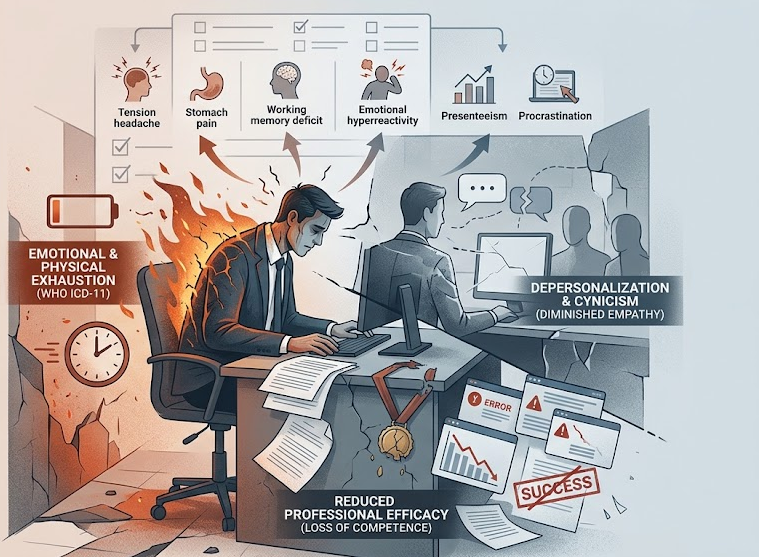
Signs of Job Burnout
Clinical diagnostic symptoms, Maslach triad markers, and a 5-stage assessment framework for occupational strain.
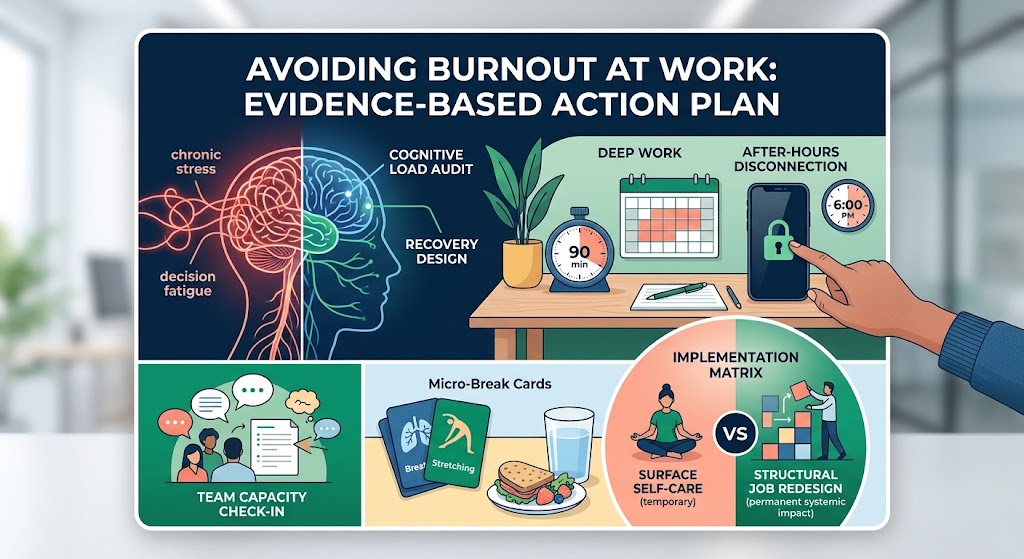
Avoiding Burnout at Work
Evidence-based workflow architecture, digital disconnection rules, and trade-off boundary protocols.
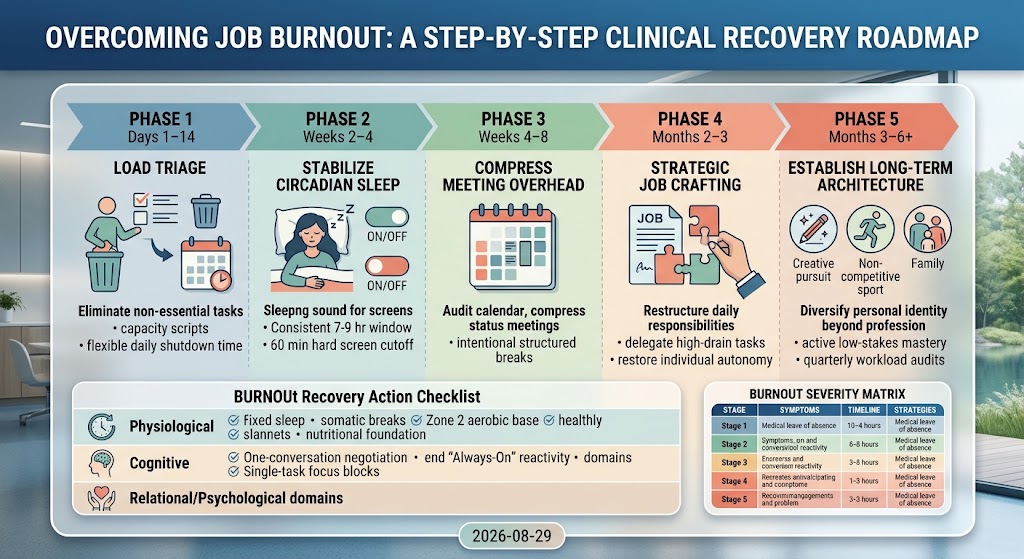
Overcoming Job Burnout
A 5-phase clinical recovery roadmap for physiological stabilization, job crafting, and nervous system repair.