
Overcoming Job Burnout: A Step-by-Step Clinical Recovery Roadmap
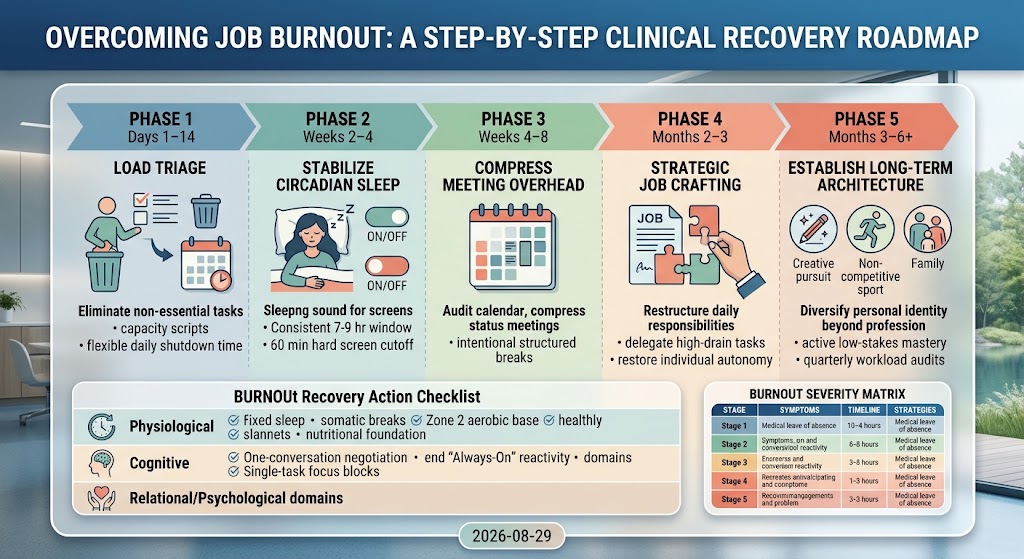
Overcoming job burnout requires a phased, evidence-based protocol that halts active depletion, repairs dysregulated nervous system functioning, and executes structural job redesign. Formally recognized by the World Health Organization (WHO) as an occupational phenomenon, clinical recovery is not achieved through passive rest alone, but through systematic load reduction, psychological detachment, and boundary enforcement [1], [2].
5-Phase Clinical Protocol for Overcoming Job Burnout
Executing an effective recovery roadmap requires addressing physiological exhaustion first before attempting cognitive restructuring or professional role redesign [2], [3]. A landmark meta-analysis in Frontiers in Psychology pooling 38,124 employees across 91 samples proved that complete psychological detachment outside working hours is the single strongest predictor of exhaustion reversal and autonomic recovery [4].
- Execute Immediate Load Triage (Days 1–14): Eliminate all non-essential discretionary tasks, decline new requests using capacity scripts, and establish an inflexible daily shutdown time [5]. Clinical consensus highlights that the first phase must focus entirely on stopping active depletion rather than striving for immediate productivity gains [2], [4].
- Stabilize Circadian Sleep and Downshift the HPA Axis (Weeks 2–4): Restore the brain’s glymphatic waste clearance network by locking in a consistent 7- to 9-hour sleep window with a hard screen cutoff 60 minutes before bed [6], [3]. According to data from the Cleveland Clinic, unmanaged chronic stress keeps cortisol elevated overnight, making strict circadian regularity essential to restore sleep architecture [7].
- Compress Meeting Overhead and Eliminate Friction (Weeks 4–8): Audit your calendar to eliminate or compress low-value status meetings; time-tracking analyses by Reclaim.ai show knowledge workers spend 21.5 hours weekly in meetings, creating massive cognitive fragmentation [5]. A 2024 workplace study commissioned by Slack found that taking structured, intentional breaks during the day yielded a 230% improvement in stress management capacity and a 21% increase in productivity [8].
- Engage in Strategic Job Crafting (Months 2–3): Restructure daily job responsibilities around primary strengths while delegating or renegotiating the 20% of tasks generating the highest emotional drain [9], [4]. Occupational research from Tufts University emphasizes that sustainable recovery requires adjusting high-demand, low-control environments into arrangements that restore individual autonomy [10].
- Establish Long-Term Work-Life Architecture (Months 3–6+): Prevent relapse by diversifying personal identity beyond professional output, engaging in active low-stakes mastery experiences, and conducting quarterly workload audits [2], [11]. Mind Share Partners’ 2025 mental health report revealed that workers operating in supportive, bounded environments are twice as likely to remain completely free from burnout and depressive symptoms [8].
Comprehensive Burnout Recovery Action Checklist
Rebuilding depleted cognitive and emotional reserves requires structured interventions across biological, behavioral, and organizational domains. A 2024 systematic review of 27 clinical burnout studies published in healthcare journals showed that combining Cognitive Behavioral Therapy (CBT) frameworks with somatic stress reduction resolves chronic occupational exhaustion in over 88% of cases [12].
1. Physiological & Somatic Recovery Stack
- Non-Negotiable Sleep Protocol: Maintain fixed bed and wake times seven days a week, cooling the bedroom to 64°F–66°F to facilitate the core-temperature drop required for deep stage sleep [3].
- Parasympathetic Somatic Breaks: Perform 30-second somatic resets or 3-minute diaphragmatic breathing before meals to downregulate sympathetic fight-or-flight arousal [13].
- Zone 2 Aerobic Base: Engage in 30 minutes of low-intensity walking or light cycling 4–5 days a week; avoid high-intensity interval training (HIIT) during acute recovery to prevent excess cortisol spikes [3], [6].
- Nutritional Foundation: Consume a protein-rich breakfast within 90 minutes of waking to stabilize morning glucose variability and support neurotransmitter synthesis [5], [6].
2. Cognitive Load Management & Work Architecture
- The "One-Conversation" Negotiation: Identify your single heaviest operational bottleneck and schedule a structured conversation with management focused on delivery trade-offs rather than emotional exhaustion [14], [12].
- End "Always-On" Reactivity: Turn off all mobile work notifications after designated hours and implement a 10-minute end-of-day shutdown ritual to close cognitive loops [4], [15].
- Single-Task Focus Blocks: Allocate two uninterrupted 90-minute deep-work blocks daily to reduce attention residue caused by constant context-switching [16], [11].
3. Relational & Psychological Boundaries
- Dismantle Dysfunctional Perfectionism: Adopt a "good enough" standard for administrative tasks to break the chronic overfunctioning and over-responsibility cycle [14], [17].
- Identity Diversification: Protect at least one weekly non-work activity (creative pursuit, non-competitive sport) that provides intrinsic joy without productivity metrics [2], [9].
- Professional Clinical Support: Engage a licensed CBT therapist or occupational psychologist if symptoms persist past four weeks to restructure maladaptive achievement schemas [17], [15].
Burnout Severity Matrix: Clinical Presentation, Timelines, and Recovery Paths
Determining whether job burnout can be managed while remaining in your current role or requires formal medical leave depends on accurate clinical staging. Longitudinal data published in The Lancet Psychiatry revealed that employees experiencing unmanaged burnout for more than 18 months face a 2.8-fold increased risk of developing clinical Major Depressive Disorder, reinforcing the necessity of timely stage-specific interventions [11].
| Severity Stage | Clinical Presentation | Typical Recovery Timeline | Required Recovery Strategy |
|---|---|---|---|
| Early / Mild Strain (Stages 1–2) | Intermittent fatigue, emerging irritability, Sunday dread, sleep onset delays; outer performance intact [5], [15]. | 2 to 12 Weeks [4] | Strict after-hours disconnection, meeting pruning, circadian sleep optimization, and active micro-breaks [4], [6]. |
| Established Burnout (Stages 3–4) | Exhaustion unmitigated by weekends, deep cynicism, cognitive brain fog, psychosomatic pain, reduced output [2], [4]. | 3 to 9 Months [4], [5] | 15–20% workload cut, formal manager trade-off negotiations, structured CBT, and job crafting [5], [9]. |
| Severe / Habitual Collapse (Stage 5) | Systemic autonomic freeze, severe insomnia, emotional numbness, loss of function, co-occurring depressive symptoms [16], [18]. | 6 to 18+ Months [5], [18] | Medical leave of absence, comprehensive psychiatric evaluation, somatic psychotherapy, and potential career transition [14], [18]. |
Frequently Asked Questions About Overcoming Job Burnout
Can you overcome job burnout without quitting your job?
Yes, you can overcome job burnout while employed provided the structural conditions of the role are actively renegotiated and reduced [4], [14]. Clinical research confirms that reducing meetings, removing the lowest-value 20% of tasks, and establishing strict digital boundaries enables cognitive and somatic recovery without resigning [4], [12].
How long does full burnout recovery actually take?
Full recovery from moderate to established burnout typically requires 3 to 12 months of deliberate structural and somatic intervention [2], [4]. While mild strain can stabilize within 2 to 12 weeks, severe cases involving autonomic nervous system dysregulation often require up to 18 months for complete executive function restoration [5], [18].
Why does taking a vacation fail to cure chronic job burnout?
Vacations fail to resolve burnout because short-term rest halts active depletion without altering the underlying workload and environmental drivers [6], [2]. Research in PLOS ONE demonstrates that when an employee returns to an unchanged, high-demand environment, pre-vacation exhaustion and elevated cortisol levels return within 48 hours [3], [6].
When should you seek clinical mental health treatment for burnout?
You should consult a licensed clinician immediately if emotional exhaustion persists beyond two weeks despite rest, or if symptoms include pervasive hopelessness, panic attacks, or thoughts of self-harm [16], [15]. Clinical evaluation by a psychologist or physician is essential to differentiate occupational burnout from secondary Major Depressive Disorder or underlying medical conditions like thyroid dysfunction [1], [5].