
Avoiding Burnout at Work: Evidence-Based Action Plan and Prevention Guide
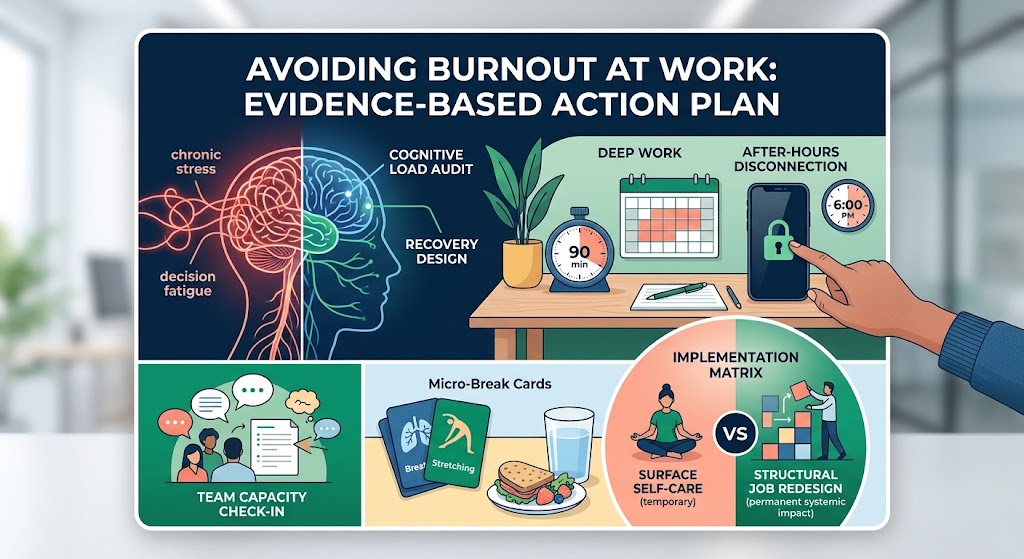
Avoiding burnout at work requires shifting from reactive coping to proactive cognitive load reduction, firm boundary architecture, and systematic recovery design. Formally recognized by the World Health Organization (WHO) as an occupational phenomenon, preventing burnout depends on managing job demands and preserving worker autonomy before chronic exhaustion causes systemic physical and psychological impairment [1], [2].
5-Step Protocol for Avoiding Burnout at Work
Executing a sustainable burnout prevention protocol requires addressing structural workflow mismatches rather than relying solely on individual willpower or personal resilience [3]. A 50,000-employee global study published in the Journal of Organizational Behavior confirmed that workplace and organizational factors account for 78% of burnout variance, proving that targeted workflow interventions yield far greater efficacy than generic stress reduction [4].
- Conduct a Weekly Cognitive Load and Friction Audit: Categorize daily work into Deep Work (high-impact focus), Shallow Work (necessary administration), and Friction Work (redundant meetings, tooling errors, multi-channel searching) [4]. Harvard Business Review data shows knowledge workers spend 58% of their time on secondary coordination, making the systematic elimination of friction the fastest route to reducing exhaustion [4].
- Implement Pre-Decided Disconnection Boundaries: Establish non-negotiable rules for digital communication cutoffs in advance rather than debating availability in real-time under high decision fatigue [5]. Clinical research from the University of Zurich demonstrates that maintaining consistent after-hours disconnection reduces systemic cortisol levels by 34% and increases job satisfaction by 41% within eight weeks [4].
- Defend 90-Minute Focus Blocks with Meeting Hygiene: Block uninterrupted deep-work windows and shorten default meeting lengths to combat attention residue [1], [6]. Research from the University of California, Irvine reveals that returning to focused attention after an interruption takes an average of 23 minutes, while Microsoft data indicates employees using six or more collaboration tools experience a 3.2-fold increase in burnout rates [1], [4].
- Practice Resonant Autonomic Modulation and Micro-Breaks: Regulate sympathetic nervous system hyperarousal during transitions by practicing resonant breathing at 4 to 6 breaths per minute for two to five minutes [7]. This pacing technique widens heart rate variability (HRV) swings, calming central nervous system stress reactivity faster than passive sitting or digital scrolling [7].
- Communicate Capacity Constraints Using Trade-Off Language: Replace emotional complaints with objective trade-off choices during managerial check-ins, such as stating: "I can deliver Project A by Thursday or complete Project B, but executing both concurrently reduces deliverable quality; which takes priority?" [3]. According to workplace research by Gallup, employees who discuss workload proactively and feel supported by their supervisors are 70% less likely to experience regular burnout [2].
Implementation Checklist: Personal, Environmental, and Team Prevention
Sustainable burnout prevention operates across individual physiological maintenance, environmental workspace design, and managerial team communication. A comprehensive meta-analysis evaluating occupational health interventions confirmed that direct workload adjustments achieve an overall exhaustion reduction effect size of −0.30, demonstrating that structural boundaries outperform passive wellness tips [3].
1. Daily Somatic & Physiological Maintenance
- Consistent Circadian Anchor: Maintain identical sleep and wake windows daily; psychiatric clinical guidance from the American Psychiatric Association notes that consistent sleep timing is as crucial as total hours in preventing adrenal exhaustion [8].
- Morning Friction-Free Protocol: Delay caffeine consumption and email triage for the first 60–90 minutes of waking to avoid cortisol-spike amplification [9], [10].
- Low-Impact Stress Clearance: Integrate 20–30 minutes of low-intensity movement or 5,000 steps daily to metabolize excess stress hormones without straining the nervous system [8], [9].
2. Workday Architecture & Task Structuring
- The 1-3-5 Prioritization Method: Limit daily output commitments to exactly 1 critical core project, 3 medium tasks, and 5 minor administrative wins to protect cognitive bandwidth [10].
- Deliberate Workday Shutdown Ritual: Spend the final 10 minutes recording unfinished items, organizing tomorrow’s list, and closing all active workspace tabs to signal neurological completion [11], [10].
- Context-Switch Batching: Restrict asynchronous messages (Slack/email) to designated hourly processing windows rather than real-time monitoring [6], [12].
3. Relational Boundaries & Managerial Alignment
- Proactive Availability Disclaimers: Place standing communication hours in email signatures to establish response expectations without personal confrontation [5], [11].
- Outcome Delegation: Delegate complete responsibility and decision-making criteria for sub-tasks rather than managing fragmented micro-steps [3].
- Psychological Safety Check-ins: Hold weekly managerial coaching dialogues; research from NAMI indicates 52% of employees experience acute burnout, which drops by 62% when leaders actively listen to operational challenges [2], [13].
Intervention Efficacy Matrix: Coping Strategies vs. Structural Redesign
Selecting the correct burnout intervention depends on distinguishing between surface-level self-care, tactical cognitive load management, and systemic organizational changes. Christina Maslach's Areas of Worklife model demonstrates that burnout emerges across six core domains—workload, control, reward, community, fairness, and values—which require structural fixes rather than isolated stress remedies [14], [15].
| Intervention Level | Primary Mechanism | Clinical & Performance Impact | Sustainability Rating |
|---|---|---|---|
| Surface Self-Care (e.g., meditation apps, spa breaks, positive reframing) | Temporarily lowers acute sympathetic nervous system arousal without altering incoming workload [16]. | Provides short-term subjective calm (15–60 minutes); fails to stop chronic exhaustion when returning to overloaded systems [5], [3]. | Low (Temporary Relief) |
| Tactical Load Management (e.g., pre-decided rules, 1-3-5 tasking, focus blocks) | Eliminates attention residue, reduces daily micro-decisions, and prevents task fragmentation [5], [4]. | Cuts after-hours cortisol by 34% and prevents daily energy depletion across knowledge workers [4]. | Moderate–High (Individual Level) |
| Structural Job Redesign (e.g., autonomy expansion, role clarity, workload redistribution) | Directly resolves mismatches between organizational expectations, resources, and worker capacity [14]. | Reduces chronic burnout likelihood by 43%–70% and lowers employee turnover by 48% across organizations [2], [4]. | Highest (Permanent Systemic Impact) |
| Active Somatic Recovery (e.g., resonant breathing, consistent sleep, low-stakes flow) | Downregulates the HPA axis and rebuilds physical and emotional energy reserves [8], [16]. | Restores heart rate variability, normalizes deep sleep architecture, and prevents functional freeze collapse [7], [16]. | High (Essential Physiological Base) |
Frequently Asked Questions About Avoiding Burnout at Work
How do you immediately stop work burnout from escalating?
You immediately stop burnout by conducting a workload triage to eliminate non-essential commitments and establishing firm daily work stop times [10], [3]. Clinical research confirms that setting strict stop times prevents the continuous accumulation of strain under the effort-recovery model, preserving baseline cognitive functioning [1], [10].
Why does traditional self-care fail to prevent job burnout?
Traditional self-care fails because it treats burnout as an individual resilience issue rather than resolving structural workplace mismatches [14], [3]. A 2026 study of 50,000 workers across 34 countries showed that organizational design factors cause 78% of burnout variance, meaning surface relaxation cannot counteract chronic work overload or lack of control [4].
How does setting strict after-hours boundaries physically protect health?
Strict after-hours boundaries deactivate continuous sympathetic nervous system engagement and allow the body to metabolize circulating stress hormones [4], [15]. Data from the University of Zurich indicates that complete psychological detachment outside work hours reduces systemic cortisol levels by 34%, protecting against cardiovascular strain and sleep architecture disruption [4], [15].
What is the most effective way to communicate workload capacity to a supervisor?
The most effective strategy is presenting concrete trade-offs using capacity-based operational language rather than expressing generalized emotional distress [3]. Gallup workplace research demonstrates that employees who actively structure workload solutions with their managers are 62% less likely to burn out regularly [2].