
Clinical Guide to Signs of Job Burnout: Diagnostic Symptoms and Assessment Framework
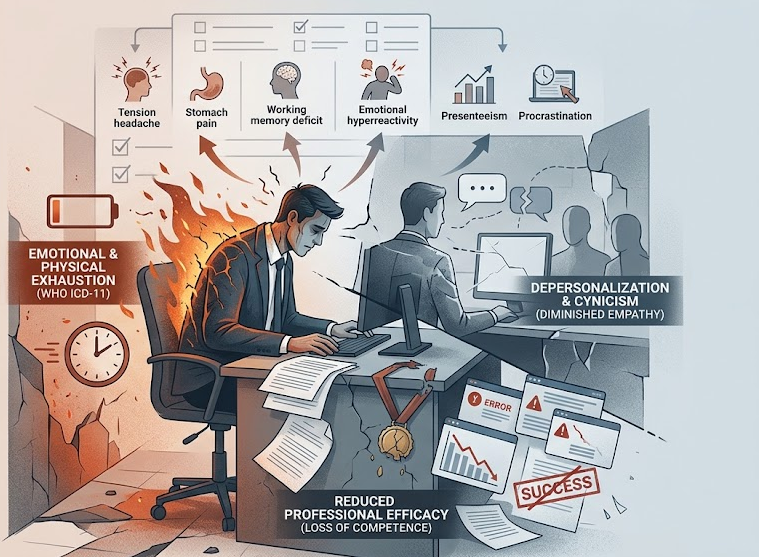
Job burnout is a state of physical, emotional, and cognitive exhaustion caused by chronic, unmanaged workplace stress. Formally classified by the World Health Organization (WHO) in the ICD-11 as an occupational phenomenon, burnout is defined by energy depletion, increased mental distance or cynicism toward one's career, and diminished professional efficacy [1], [8].
Clinical Dimensions and Primary Signs of Job Burnout
Job burnout is a tri-dimensional syndrome that develops sequentially when prolonged workplace demands exceed an individual's coping capacity and recovery resources [8]. According to foundational psychometric research by Christina Maslach and Michael Leiter published in World Psychiatry, burnout does not present as simple fatigue, but as a simultaneous systemic collapse across three distinct clinical axes [8]. Epidemiological surveys by the American Psychological Association indicate that 79% of employees experience acute workplace stress, which serves as the primary gateway to clinical burnout when unmanaged [2].
- Emotional and Physical Exhaustion: The hallmark first dimension characterized by severe energy depletion that cannot be restored by conventional rest or weekends off [8]. Longitudinal meta-analyses in the Journal of Vocational Behavior confirm that exhaustion acts as the central catalyst driving the entire burnout cascade [8].
- Depersonalization and Cynicism: A defensive psychological detachment where professionals develop callous, negative, or indifferent attitudes toward colleagues, clients, and organizational missions [3], [8]. According to research from Boston University, this coping mechanism emerges to place emotional distance between the worker and an intolerable environment [3].
- Reduced Professional Efficacy: A profound internal sense of incompetence, loss of productivity, and chronic self-doubt regarding one's ability to achieve meaningful work outcomes [3], [8]. The APA's Work in America survey revealed that 26% of workers feel a total lack of motivation and 18% experience pervasive ineffectiveness due to this dimension [5].
Categorized Checklist: Intrapersonal, Interpersonal, and Occupational Indicators
Diagnostic indicators of workplace burnout manifest across three distinct operational domains: intrapersonal changes within the individual, interpersonal dynamics with others, and objective occupational behaviors. A 45-study review in Frontiers in Public Health established this multi-domain structure to assist clinicians and managers in identifying early warning markers before permanent physiological impairment occurs [7].
1. Intrapersonal Markers (Physical and Cognitive)
- Unrestorative Sleep & Insomnia: Waking up exhausted despite 7–8 hours in bed, frequently triggered by nocturnal rumination over unmanaged work demands [8], [11].
- Psychosomatic Pain: Frequent tension headaches and musculoskeletal stiffness; clinical studies in the Journal of Psychosomatic Research show that 65% of individuals experiencing burnout suffer from recurring headaches compared to 41% of non-burnout controls [5].
- Gastrointestinal Distress: Chronic stomach pain (present in 64.5% of cases) and bowel irregularities (present in 57.2% of cases) resulting from sustained hypothalamic-pituitary-adrenal (HPA) axis activation [5], [11].
- Executive Cognitive Weariness: Measurable deficits in working memory, impaired concentration, and decision fatigue, formal subscales measured by the Shirom-Melamed Burnout Measure [8].
- Anticipatory Somatic Dread: Severe physical tension, nausea, or tachycardia on Sunday evenings or prior to entering the work environment [10].
2. Interpersonal and Emotional Markers
- Emotional Hyperreactivity: Severe loss of emotional regulation resulting in disproportionate anger, tearfulness, or frustration over minor workplace setbacks [10].
- Empathy Erosion (Compassion Fatigue): Dehumanizing interactions with clients, patients, or peers, treating individuals as administrative burdens or numbers [4], [10].
- Social Withdrawal: Deliberately avoiding team lunches, muting communication channels, and isolating oneself from collaborative duties to conserve depleted psychological bandwidth [7], [12].
- Interpersonal Spillover: Displacing occupational hostility and impatience onto spouses, children, or friends outside the work environment [2], [10].
3. Occupational and Behavioral Markers
- Presenteeism: Remaining physically logged in or present while operating at minimal cognitive capacity, staring at screens without completing deliverables [10]; Spring Health data indicates 40% of burned-out workers identify as mentally checked out [12].
- Unhealthy Overcommitment: Paradoxically taking on excessive workloads and working late to overcompensate for feelings of falling behind, a behavior driven by maladaptive perfectionism [7], [12].
- Chronic Procrastination and Avoidance: Deferring fundamental routine tasks that previously required negligible effort [13].
- Maladaptive Coping: Escalating reliance on stimulants (caffeine), sedatives, alcohol, or compulsive digital scrolling to numb chronic nervous system hyperarousal [1], [10].
Diagnostic Framework: 5-Stage Assessment and Clinical Evaluation
Tracking the progression of job burnout requires evaluating an employee's symptom trajectory across five clinical stages to determine the urgency of structural and therapeutic intervention. According to clinical models outlined by the Cleveland Clinic and psychometric validation studies on the Burnout Assessment Tool (BAT), burnout evolves gradually rather than occurring instantaneously [6], [14].
- The Honeymoon / High-Commitment Phase: Driven by high energy, excessive ambition, and perfectionism. The worker absorbs unsustainable workloads, ignores early fatigue, and equates excessive busyness with professional dedication [6], [10].
- Onset of Stress and Over-Adaptation: Awareness of stress emerges alongside episodic sleep disruption, irritability, and cognitive friction. The individual pushes through via sheer willpower and increased stimulant consumption [6].
- Chronic Stress and Physiological Strain: Persistent exhaustion sets in. Weekends fail to restore baseline vitality. Chronic physical symptoms (tension headaches, gastrointestinal upset, weakened immunity) appear as the HPA axis remains dysregulated [6], [11].
- Clinical Burnout (Tri-Dimensional Crisis): Full manifestation of emotional exhaustion, acute cynicism, and a subjective collapse of professional competence. Performance drops, absenteeism increases, and presenteeism becomes chronic [6], [12].
- Habitual Burnout and Systemic Collapse: Burnout becomes the permanent baseline state. Unaddressed habitual burnout substantially elevates the risk of secondary clinical depression, anxiety disorders, and cardiovascular disease [6], [8].
Diagnostic Comparison: Acute Stress vs. Job Burnout vs. Major Depression
Differential diagnosis between acute stress, occupational burnout, and major depressive disorder is vital because the conditions require fundamentally different management pathways. A systematic meta-analysis in Frontiers in Psychology by Koutsimani et al. confirmed that while burnout and depression share phenotypic overlaps (such as fatigue and loss of interest), burnout remains domain-specific to the occupational environment, whereas depression is pervasive across all life dimensions [1], [8].
| Diagnostic Parameter | Acute Workplace Stress | Workplace Burnout Syndrome | Major Depressive Disorder |
|---|---|---|---|
| Core Affective State | Overwhelmed, urgent, overactive emotional state ("Too much pressure") [9]. | Depleted, hollow, indifferent, cynical ("Too little emotional reserve") [9]. | Pervasive despair, anhedonia, worthlessness, global emptiness [5], [8]. |
| Contextual Specificity | Bound to specific deadlines or temporary project spikes [11]. | Bound primarily to the workplace and professional role [8]. | Generalized across all life spheres (work, family, hobbies, social) [6], [8]. |
| Response to Rest / Leave | Rapid recovery following project completion or a weekend off [11]. | Temporary mitigation during leave; exhaustion returns upon re-entry [10]. | Symptoms persist during vacations or removal from stressors [6]. |
| Efficacy & Motivation | High drive to perform despite acute pressure [2]. | Efficacy drops; deep cynicism and perceived futility of effort [3], [8]. | Global loss of interest and inability to experience pleasure (anhedonia) [15]. |
| Primary Interventions | Time management, short-term task delegation, brief rest [8]. | Structural job redesign, autonomy enhancement, cognitive restructuring [8], [10]. | Clinical psychotherapy (CBT/psychiatric care), pharmacotherapy [1], [9]. |
| Clinical Classification | Adaptive physiological stress response [11]. | ICD-11 Occupational Phenomenon (QD85) [1], [8]. | DSM-5 / ICD-11 Diagnosable Mood Disorder [5]. |
Frequently Asked Questions About Burnout Job Symptoms
What are the primary signs of job burnout?
The primary signs of job burnout consist of unyielding emotional and physical exhaustion, depersonalization or cynicism toward work, and a measurable decline in professional efficacy [1], [3]. The WHO classifies these three dimensions as mandatory indicators of the syndrome, distinguishing it from temporary fatigue [3], [8].
How do you clinically differentiate burnout from depression?
Burnout is contextually tied to chronic occupational stressors, whereas clinical depression is a mood disorder that pervades all life domains regardless of external work circumstances [6], [8]. Research in Frontiers in Psychology highlights that burnout symptoms temporarily ease when removing the individual from the work environment, whereas depressive symptoms follow the individual across environments [6], [8].
What physical health risks are linked to unaddressed workplace burnout?
Unaddressed burnout prospectively predicts severe systemic conditions, including a 20% to 30% increased risk of cardiovascular disease, hypercholesterolemia, and type 2 diabetes [8]. Prospective cohort studies published in PLOS ONE confirmed that chronic burnout more than doubles the risk of developing musculoskeletal disorders and predicts premature mortality below age 45 [8].
Can an employee experience burnout while maintaining high productivity?
High-functioning burnout occurs when individuals maintain high output through perfectionism, overcommitment, and willpower despite experiencing internal emotional depletion [7], [11]. In these cases, cognitive exhaustion and cynicism accumulate silently for months before an eventual drop in observable work performance occurs [7], [12].