
Conflict Resolution in Relationships: A Step-by-Step Clinical Guide
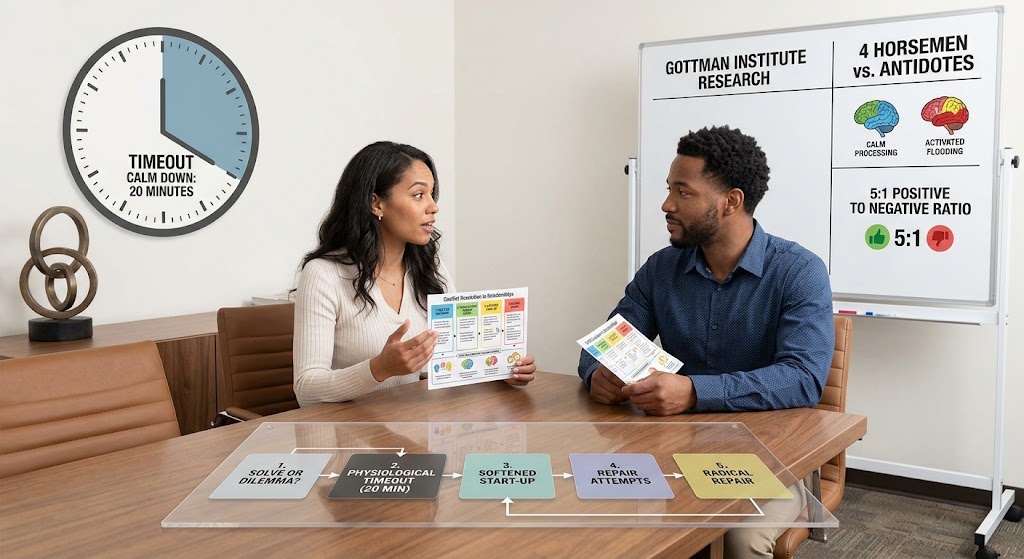
Mastering conflict resolution in relationships requires de-escalating physiological flooding, distinguishing solvable problems from perpetual differences, and executing structured repair attempts. Decades of longitudinal research from The Gottman Institute show that relationship longevity depends not on eliminating disagreements, but on maintaining a 5:1 ratio of positive-to-negative interactions and replacing destructive defensiveness with emotional attunement [1], [2].
5-Step Clinical Protocol for Resolving Relationship Conflict
Effective conflict resolution in intimate relationships requires treating disagreements as biological and communication patterns rather than character flaws [3]. Longitudinal research by Dr. John Gottman reveals that 69% of relationship conflicts are perpetual problems rooted in fundamental personality differences, proving that successful couples manage recurring themes through ongoing dialogue rather than forcing artificial resolutions [2], [4].
- Sort the Issue (Solvable vs. Perpetual Dilemma): Determine whether the conflict is situational (e.g., household chore division) or perpetual (e.g., introvert vs. extrovert lifestyle needs) before debating solutions [4], [5]. In a 2026 study published in Psychology Today, relational resilience—the ability to understand underlying dreams rather than attempting to eliminate core differences—was shown to be the primary buffer protecting relationship satisfaction [6], [5].
- Enforce a 20-Minute Physiological Timeout When Flooded: If either partner’s heart rate exceeds 100 BPM or somatic tension rises (clenched fists, tight chest), halt the discussion immediately for a minimum of 20 minutes to allow the nervous system to return to baseline [1], [7]. Clinical research from Mastering Conflict indicates that physiological flooding completely disables prefrontal cortex processing, making empathetic negotiation neurologically impossible during adrenaline surges [7], [3].
- Initiate with a Softened Start-Up: Open grievances by describing your personal feelings and specific needs without accusing your partner's character, using the formula: "I feel [emotion] about [specific situation], and I need [concrete behavioral request]" [1], [4]. Gottman’s newlywed laboratory studies prove that the emotional tone of the first three minutes of a disagreement predicts the outcome of the entire conversation with over 90% accuracy [4].
- Deploy and Accept In-Flight Micro-Repair Attempts: De-escalate rising friction using pre-agreed verbal cues, humor, or physical touch, such as stating: "I think I’m getting defensive, can we reset?" [8], [4]. Peer-reviewed findings in Psychology Today demonstrate that the success of repair attempts is among the single strongest predictors of marital longevity, neutralizing hostility before contempt takes root [8].
- Execute Radical Repair and Joint Problem-Solving: Reconnect by validating your partner's emotional reality without defending intentions, owning your contribution to the rupture, and agreeing on actionable future steps [6], [9]. Research from the Columbia University Difficult Conversations Lab highlights that framing relational disputes around complex, multi-angle perspectives achieves complete joint resolution compared to binary, win-lose debating formats [10].
Implementation Checklist: Pre-Conflict Rules, Active Attunement, and Repair
Constructing a durable conflict resolution framework requires structured habits that govern pre-conflict boundaries, active communication, and post-argument reconciliation. Clinical outcome research cited by National University demonstrates that couples who practice structured communication protocols and Emotionally Focused Therapy (EFT) principles report a 70% rate of significant, long-term relationship improvement [11], [12].
1. Peacetime Ground Rules & De-Escalation Architecture
- Establish Non-Negotiable Boundaries: Mutually agree in advance to eliminate yelling, name-calling, physical intimidation, and bringing up past grievances during arguments [13], [14].
- Designate a Shared Safe Word: Select a neutral safe word (e.g., "Pause" or "Oklahoma") that immediately halts dialogue for 20 minutes with zero penalty or debate [15], [7].
- Time-Box Complex Discussions: Limit difficult relationship conversations to 45–60 minutes, avoiding late-night discussions when cognitive and emotional exhaustion is elevated [16], [17].
2. In-Conflict Active Attunement
- Speaker-Listener Paraphrasing: Practice Carl Rogers’ active listening method by summarizing your partner's core emotion before responding: "What I hear you saying is that you felt unsupported when I stayed late; did I get that right?" [16], [18].
- The "Two Tokens" Technique: Disarm defensiveness by meeting your partner’s emotional intensity with validation rather than minimization, turning "It's a big deal" into collaborative problem-solving [15].
- Avoid "Why" Interrogations: Replace accusatory "Why did you...?" questions with open-ended inquiries such as "Can you tell me more about what you experienced?" to reduce relational threat [16].
3. Post-Conflict Repair & Reconnection
- Clear-Cut Accountability: Take unreserved ownership of your role in the argument without appending excuses: "I apologize for speaking harshly when I felt stressed" [19], [20].
- Somatic Reassurance: Engage in physical touch (hugging, holding hands) following resolution to stimulate oxytocin release and signal safety to the autonomic nervous system [21].
- Weekly State-of-the-Union Check-Ins: Conduct a 20-minute weekly alignment meeting to review what felt supportive and resolve minor friction before resentment accumulates [11], [15].
Conflict Matrix: Gottman's Four Horsemen vs. Clinical Antidotes
Identifying the four toxic communication patterns identified by Dr. John Gottman—termed the "Four Horsemen of the Apocalypse"—is essential for preventing relationship deterioration. Longitudinal clinical studies show that the chronic presence of contempt and stonewalling predicts relationship dissolution with over 93% accuracy unless countered by specific behavioral antidotes [1], [20].
| Destructive Pattern (Horseman) | Behavioral Manifestation | Evidence-Based Clinical Antidote | Relational Impact |
|---|---|---|---|
| Criticism | Attacking the partner's core personality: "You never think of anyone but yourself." [1] | Softened Start-Up: State a specific feeling and positive request without global blame [1], [4]. | Prevents defensive escalation and keeps focus on problem-solving [20]. |
| Contempt | Communicating from moral superiority: mockery, sarcasm, eye-rolling, hostile insults [1], [20]. | Build Culture of Appreciation: Regular verbal gratitude during peacetime; express fondness and respect [1]. | Eliminates the #1 predictor of divorce and restores mutual dignity [20]. |
| Defensiveness | Playing the victim, counter-attacking, or making excuses: "It’s not my fault, you did it first." [1] | Take Responsibility: Acknowledge even a small percentage of your partner’s perspective [1], [20]. | Disarms arguments instantly and creates a collaborative alliance [9]. |
| Stonewalling | Emotional shutdown, going silent, walking out, or giving one-word dismissals [1], [4]. | Physiological Self-Soothing: Announce a 20-minute break, engage in deep breathing, then return [1], [7]. | Calms autonomic flooding and preserves emotional safety [3]. |
Frequently Asked Questions About Conflict Resolution in Relationships
Why do most recurring arguments in relationships never get fully resolved?
Approximately 69% of recurring conflicts are perpetual problems stemming from unchangeable personality traits, core values, and lifestyle preferences [2], [4]. Gottman Institute research confirms that healthy couples do not eliminate these differences, but establish ongoing dialogue and humor around them to avoid emotional gridlock [2], [4].
What is the biological reason couples cannot solve problems when angry?
During high-conflict arguments, physiological flooding triggers adrenaline and cortisol surges, elevating heart rates past 100 BPM [1], [3]. This evolutionary threat response takes the prefrontal cortex offline, disabling cognitive empathy and perspective-taking until a 20-minute self-soothing break occurs [3], [7].
What is the single most destructive behavior during relationship conflict?
Contempt—communicating through sarcasm, mockery, and eye-rolling from a position of superiority—is the single strongest predictor of relationship breakdown [1], [20]. Decades of clinical observation prove that contempt erodes mutual respect and immune health, requiring an active culture of appreciation as an antidote [1], [20].
What is the "magic 5:1 ratio" in relationship stability?
The 5:1 ratio represents the finding that stable, thriving couples maintain at least five positive interactions for every one negative interaction during conflict [1], [15]. This emotional reserve allows partners to make and receive repair attempts successfully, buffering the relationship against destructive escalation [1], [4].