
Mind Over Medicine: The Tech Revolution Reshaping Mental Health
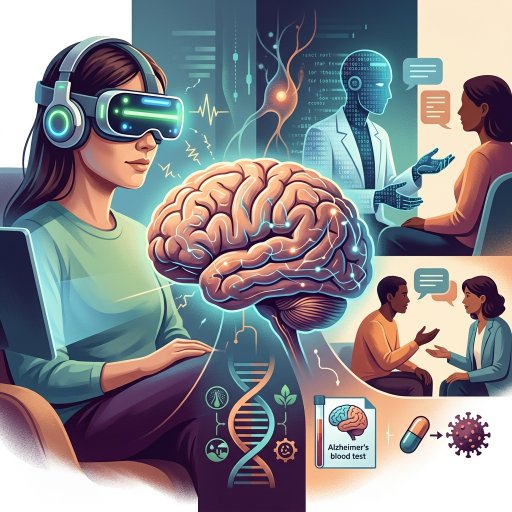
The thing you need to understand about the current push to solve mental health with hardware is that the brain isn’t a smartphone. This week, the FDA cleared the first neurostimulation device for PTSD—a sleek headset worn for 30 minutes while you watch TV—just as the VA launched a strict, long-delayed trial of MDMA-assisted therapy. Meanwhile, new genetic studies reveal a reality so complex it makes a mockery of the AI chatbots currently storming the therapist’s office. The gap between the sales pitch and the science has never been wider.
PLUS: A new Alzheimer’s blood test outperforms the gold standard—and a massive study on childhood antidepressants reveals a hidden risk for long COVID.
Here is the question no one is asking in Silicon Valley: If a wearable device can meaningfully treat PTSD for $600, and a clinical-grade AI therapist is just a $20 monthly subscription away, why is the government spending $23 million to study psychedelics until 2030?
Following: A tale of two PTSD treatments
The headline this week belongs to Neurovalens. The Belfast-based company secured FDA clearance for its Modius Spero device, a headset that delivers small electrical pulses to the skin behind each ear. The target is the vestibular cranial nerve, a pathway to the deep brain regions regulating stress. In a 383-adult trial, two-thirds of users reported meaningful symptom improvement. It is a user-friendly, 30-minute-daily ritual. Veterans, a population that faces disproportionate PTSD rates, will be the first to access it through the VA this summer.
It is a rare piece of good news—a non-invasive, non-pharmaceutical option for a condition where treatment has long stagnated on talk therapy and SSRIs. The Chief Executive Officer, Jason McKeown, framed it as an integrated tool, not a silver bullet. "Modius Spero can be used alongside standard-of-care treatments," he noted. A reasonable, clinical position.
Now, contrast that with the other PTSD news. A new VA trial for MDMA-assisted therapy just registered at ClinicalTrials.gov. It will enroll 80 veterans with severe, treatment-resistant PTSD and a co-occurring alcohol use disorder. The design is randomized, placebo-controlled, and double-blind—specifically structured to survive the regulatory scrutiny that caused the FDA to reject MDMA therapy in August 2024. Results are expected in May 2030.
One solution earns a press release, a reimbursement strategy, and a summer launch. The other earns a clinical trial number and a half-decade wait.
The thing you need to understand about this dichotomy is that it has nothing to do with efficacy and everything to do with regulatory physics. A device that manipulates electrical signals is a hardware problem. The FDA can model it, measure its output, and constrain its risks. A psychedelic compound that manipulates consciousness is a chemistry problem—and a political one. As one source familiar with the matter told me, "Building to FDA specifications should mean tighter controls. A weak trial can actually set the field back."
In 2019, the psychedelic renaissance was supposed to be the next frontier of mental healthcare, a correction to the dry science of selective serotonin reuptake inhibitors. Not anymore. The safe money is now on the electronics resting behind your ear. It is a low-friction solution for a high-friction world. The only thing it asks of you is to sit still for 30 minutes.
The AI Problem
If the hardware path is cautious optimism, the software path is utter recklessness. A new commentary in the International Journal of Mental Health Systems takes direct aim at the "overinflation of claims" surrounding Large Language Models in youth mental health. The authors warn that technology companies are creating "unrealistic expectations that may lead to detrimental outcomes for patients."
I have been telling people for years that the "therapeutic alliance"—the bond between clinician and patient—is not a bug in the mental health system. It is the feature. An LLM cannot form one. It can only imitate the linguistic patterns of one. The commentary puts it bluntly: AI systems can "propagate misinformation and cause harm to vulnerable populations." The risk isn’t just that these chatbots are wrong; it’s that they are convincingly wrong, and we are deploying them on populations whose brains are, by definition, still developing.
It feels like we are routing around the hard problem of human empathy with a statistical trick. And while the AI hype cycle churns on, the actual biology of the brain is revealing itself to be almost impossibly nuanced.
This week, a blizzard of genetic studies landed, and they all point to the same conclusion: the reductionist fantasy of a "gene for X" is dead. A multi-center cohort study in the European Journal of Human Genetics established CMIP as a novel gene for neurodevelopmental and neuropsychiatric disorders—autism, ADHD, epilepsy. In Molecular Psychiatry, a study of 10,000 twins mapped a "neurodevelopmental spectrum" that cuts across traditional diagnostic boxes, showing that these traits are up to 82% heritable but predict different outcomes depending on context.
And then there is the massive UK Biobank study in Communications Medicine. Researchers looked at 180,000 adults to see if the genetic variants that give you heart disease or depression are the same variants that change how you react to childhood trauma. The answer was a resounding, absolute no. The main effect genes do not overlap with the environment-interaction genes. This means that building a genetic risk score—or an AI prediction model—without accounting for context is, scientifically speaking, missing the entire point.
Your DNA reacts to feeling unloved as a child in a way that standard risk models cannot see. A chatbot cannot see it either.
The Splintered Brain
There is genuine, breathtaking progress happening, but it demands a humility that tech entrepreneurs rarely possess. In Nature Medicine, a team identified 34 circular RNAs in the blood that predict Alzheimer’s disease. The model achieved an AUC of 0.945, significantly outperforming plasma pTau217, the current gold standard blood test. It also outperformed pTau217 in predicting who would progress to symptomatic Alzheimer’s. The test is non-invasive, scalable, and specific to Alzheimer’s—it doesn't light up for Parkinson’s or frontotemporal dementia.
This is the kind of rigorous, longitudinal biomarker science that changes clinical practice. It is built on 1,221 individuals and replicated in independent cohorts. It is a paper of record, not a whitepaper.
But here is the cautionary tale, and it comes from the Nature Mental Health journal. A retrospective cohort of 110,955 children and adolescents with pre-existing neuropsychiatric conditions looked at the relationship between SSRI/SNRI use and long COVID. This is the RECOVER initiative, funded by the National Institutes of Health, a massive, multi-system data pull.
The findings stopped me cold. Pre-infection SSRI/SNRI use was associated with a lower risk of fever, chills, and hair loss. Read that again: the drugs helped with those symptoms. But. They were also associated with a significantly higher risk of neurological and systemic outcomes. We are talking about a 1.84-fold higher risk of cognitive dysfunction. A 1.33-fold higher risk of postural orthostatic tachycardia syndrome. A 1.93-fold higher risk of thromboembolic events.
Medications we hand to teenagers to stabilize their mood are apparently warping the immune and autonomic response to a virus in ways we are only just beginning to detect. A fragment here for emphasis: A higher risk of blood clots and autonomic collapse. In children.
In 2020, we talked about "hammering" the virus with a unified immune response. By 2026, the data is showing us a splintered reality where the biology of mental health is deeply intertwined with the biology of infection, and pushing on one node has catastrophic, unpredictable consequences elsewhere.
Not anymore
So where does this all end? I’ve been asking sources that question all week, and the answer I keep returning to is a bleak one. We are stratifying into two tiers of brain health. Tier one is the consumer-grade tech: the headsets, the mindfulness apps, the AI wellness coaches. They are precise in their engineering and scalable. They ask little of the system and promise optimization.
Tier two is the real science: the VA trial that requires a trained therapist to sit with a veteran for eight hours during an MDMA session, the geneticists piecing together the neurodevelopmental spectrum across a decade of a child’s life, the research consortia dissecting the terrifying link between SSRIs and POTS.
The tragedy is that tier two is where the hardest cases live, but the investment and the narrative velocity are locked into tier one. Neurovalens has a device that stimulates a nerve; to prove it worked, they had to run a rigorous clinical trial. The VA is running a trial to prove that talk therapy plus a molecule works. The AI companies are running an experiment on the public to prove that their chatbot is "engaging."
If the value is in the information, not the writing, then people will care less that AI did most of the writing. If the value is in voice and opinion and argument and analysis, it's cheap to use AI to do the whole thing. I’ve spent the past week trying to figure out if we are witnessing the birth of a real, functional model for tech-enabled mental health, or just a great pitch deck. The FDA clearance is a win for Neurovalens. The VA trial is a critical, serious step. But the genetic and immunological data are screaming at us to be careful. The brain is not a circuit to be zapped or a text stream to be predicted. It is a product of genes, environment, and time.
If we confuse a startup’s exit for a medical solution, we are guilty of the exact same magical thinking the International Journal of Mental Health Systems is warning us about: mistaking the simulation of care for care itself.
Talk to us
Send tips, comments, and questions. We read everything, even if we can’t respond to all of it.

Related Articles
One-Dose Depression Relief
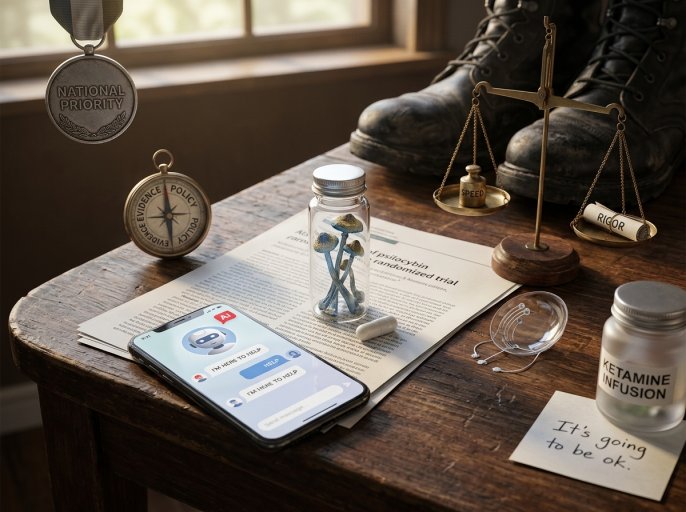
A single dose of psilocybin can provide rapid relief from depression, according to a new randomized trial—but the study also reveals the methodological challenges that haunt psychedelic research.
The Unseen Crisis
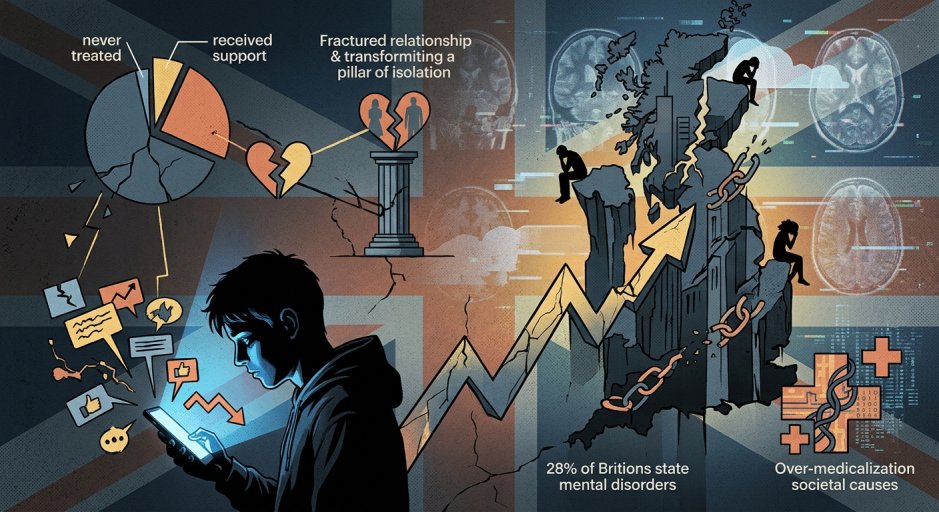
It is now statistically normal for a young person seeking mental health information online to report frequent thoughts of suicide. The data is unambiguous.
Redefining Mental Wellness
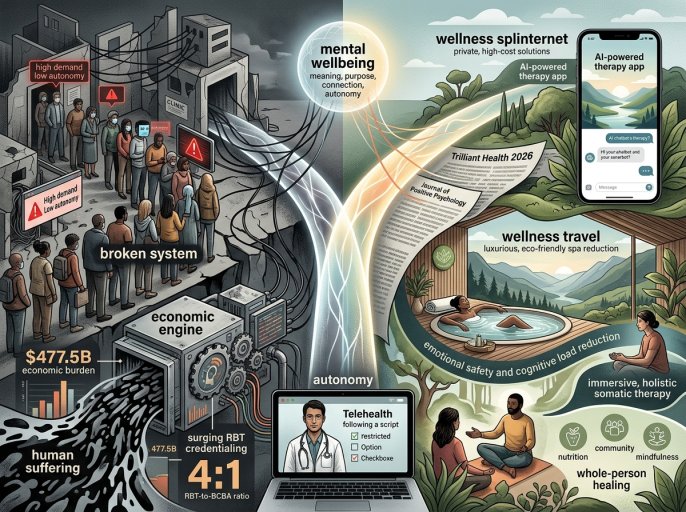
The United States is experiencing a historic behavioral health crisis—and the systems built to address it are being reshaped, not by clinical need, but by economic incentives, technological band-aids, and the logic of consumer markets.