
One-Dose Depression Relief
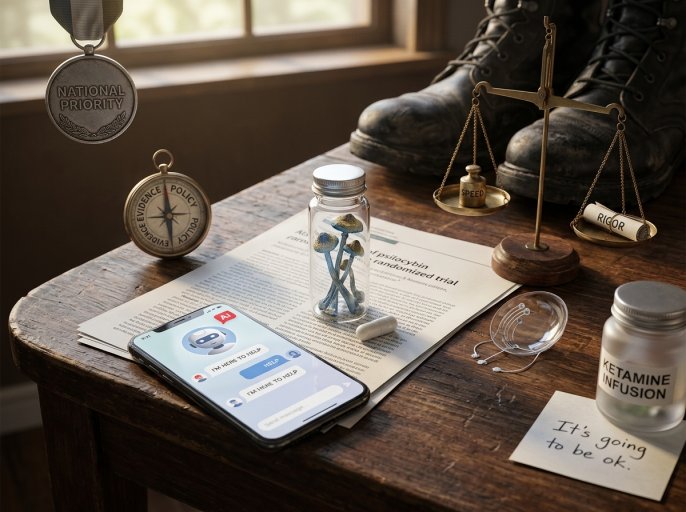
A single dose of psilocybin can provide rapid relief from depression, according to a new randomized trial—but the study also reveals the methodological challenges that haunt psychedelic research.
PLUS: A new executive order aims to fast-track psychedelic therapies for veterans, raising questions about the balance between urgency and evidence.
The thing you need to understand about the current moment in mental health treatment is that everyone is looking for a shortcut. The pharmaceutical industry has been churning out SSRIs for decades with diminishing returns. The therapist shortage is real. The waiting lists are months long. And now, from multiple directions at once, a set of alternative approaches are converging: psychedelic drugs, brain stimulation, AI chatbots, and executive orders. Each promises something the current system cannot deliver: speed. The question is whether speed comes at the cost of rigor.
Following: The psilocybin effect — but at what cost?
This week, researchers at Karolinska Institutet published the first randomized, double-blind study in Sweden of psilocybin for common depression in JAMA Network Open. The headline numbers are striking: a single 25 mg dose reduced MADRS scores by an average of 9.7 points after eight days, compared to 2.4 points for the active placebo. By six weeks, 53 percent of the psilocybin group was in remission versus 6 percent of the placebo group. The effect was detectable as early as day two. It feels like a breakthrough — and in some ways it is. This is the first phase 2 trial to demonstrate that psilocybin works for common depression, not just the cancer-related or treatment-resistant kind that have been the focus of most prior studies. The researchers provided five psychotherapeutic support sessions alongside the dose, which is a more realistic protocol than pure pharmacology.
But here’s the question: If almost all participants could guess which treatment they received, how much of the effect is real and how much is expectation? The study acknowledges this directly: “If participants and researchers can tell whether psilocybin or placebo was given, it becomes harder to separate the effect of the treatment from that of expectations.” This is the blinding problem that plagues all psychedelic research. Niacin produces a flush but not a mystical experience. The result is that the trial is essentially open-label in practice, regardless of the design. This doesn’t mean the effect is all placebo — the magnitude of the response and the persistence of the effect suggest real biology — but it means we need to be cautious about the precision of the effect size. The study also had only 35 participants. That’s not a phase 3 trial. Two participants reported severe and persistent anxiety requiring medical attention. The long-term effects are uncertain. The one-year follow-up showed no confirmed difference between groups because many placebo participants had recovered. The researchers note that repeated dosing may be needed. Not yet a panacea.
The executive order signed by President Trump in April does not help. It directs the FDA to fast-track psychedelic drugs with Breakthrough Therapy designation using a new voucher program called the Commissioner’s National Priority Voucher. It also orders the FDA and DEA to establish a pathway for eligible patients to access psychedelics, including ibogaine, and allocates at least $50 million to work with state governments. Veterans’ advocates have pushed for this for years. The VA funded its first MDMA-assisted therapy study since the 1960s in December 2024. In November 2025, it expanded trials to nine additional facilities. The executive order escalates this dramatically. It feels like the right thing to do for veterans suffering from treatment-resistant PTSD and depression. But the thing you need to understand about fast-tracking is that it shortens the time for safety data to accumulate. The history of psychiatry is littered with treatments that were rushed to market and later found to have serious harms. The psychedelic industry is already a gold rush. This order will pour more fuel on that fire.
The ketamine chronicles: Elon Musk’s favorite therapy
It feels impossible to discuss modern depression treatment without acknowledging the ketamine phenomenon. Elon Musk’s recent interview with Don Lemon, in which he disclosed taking small amounts of ketamine every two weeks under prescription to alleviate negative mental states, has brought the drug into the popular conversation. Ketamine has been used as an anesthetic since the 1970s, but its repurposing for depression is more recent. Thomas Insel, former director of the NIMH, called it “the most important breakthrough in antidepressant treatment in decades” back in 2014. The evidence is real: rapid reduction in suicidal ideation within hours, significant improvement in treatment-resistant depression. Spravato, the esketamine nasal spray from Johnson & Johnson, was FDA-approved in 2019. But the off-market ketamine clinic industry is a wild west. There is no standard dosing protocol, no long-term safety data for repeated use, and no oversight of the psychological support provided. The case report published in Frontiers in Psychiatry describing a medical student typing journals during ketamine infusions is touching — “It’s going to be ok. I’m going to be ok” — but it is not evidence. It is a data point. The broader point is that when Elon Musk says he finds ketamine useful, it normalizes a treatment that is still being studied. That has benefits and risks. When a celebrity endorses a treatment, thousands of people ask their doctors for it. That is a good thing if the treatment works and is safe. It is a bad thing if the infrastructure to deliver it safely is not there. I find myself ambivalent. Ketamine works for some people. It is not a first-line treatment. It is expensive. It requires monitoring. And it is addictive for some. The hype obscures the nuance.
Following: Brain-stimulating contact lenses
A team of materials scientists at the University of Utah published a paper in Cell Reports Physical Science describing soft, transparent contact lenses with built-in electrodes that deliver mild electrical signals to the brain via the retina to stimulate regions associated with depression. In mice, three weeks of treatment reduced behavioral, neural, and physiological signs of depression comparable to fluoxetine. The contact lenses use a method called temporal interference to target specific brain regions. The technology is clever. It is also very early. The next steps include making the lens fully wireless, testing in larger animals, and then clinical trials in humans. That process will take years. The press coverage has been breathless. I am skeptical. This is a solution in search of a problem when the problem is that we cannot reliably measure depression in humans, let alone in mice. The machine learning model the researchers used to group mice based on behavior, brain activity, and biomarkers grouped the treated mice with non-depressed controls. That is interesting. It is not a clinical trial.
The AI therapy problem
The trial of Emohaa, a generative AI chatbot designed to provide empathetic conversational support to young adults with emotional distress, is another example of the speed-rigor tension. The protocol describes a three-arm randomized trial comparing six weeks of weekly 30-minute chatbot sessions to traditional counseling and a waitlist control. The chatbot uses fine-tuned large language models to simulate supportive conversations. The study is registered and has clear outcomes. It also raises the question that I keep asking: If the value is in the information, not the writing, then people will care less that AI did most of the writing. If the value is in voice and opinion and argument and analysis, it’s cheap to use AI to do the whole thing. The same principle applies to therapy. If the value is in the relationship with a human who can challenge you, validate you, and hold you accountable, then an AI chatbot is not a substitute. But if the value is in simply having someone — anyone — to talk to, and if the alternative is nothing, then a good-enough chatbot is a huge improvement. The ethics of AI therapy are being worked out in real time. Stanford Brainstorm has published a Framework for Healthy AI and the Stanford GenAI Psychological Safety Plan. The HOPE Labs network is building a faith-informed mental health companion called HOPE AI. The field is moving fast. The thing you need to understand is that regulation is not keeping up. The FDA has not yet decided whether AI therapy apps are medical devices. The FTC is watching. The liability questions are unresolved. If a user becomes suicidal after a chatbot session, who is responsible? The developer? The clinician who recommended it? Nobody knows. We are building the mental health infrastructure of the future on a legal and ethical foundation that does not exist yet.
The policy accelerator: Fast-tracking psychedelics
The executive order on psychedelics is not just about veterans. It signals a broader shift. For decades, the federal government treated psychedelic research as a pariah. The Controlled Substances Act classified psilocybin and MDMA as Schedule I drugs with no accepted medical use. Researchers had to jump through hoops. Funding was scarce. The VA’s December 2024 announcement that it was funding MDMA-assisted therapy for PTSD was the first such study in sixty years. Not anymore. Now we have an executive order directing the FDA to fast-track promising drugs, establish access pathways for ibogaine, and spend at least $50 million to work with states. The Compassionate Access Act introduced in the Senate would require the VA to designate at least five medical facilities as “Innovative Therapies Centers of Excellence.” The bill’s cosponsor, Sen. Ruben Gallego, said it would “ensure the VA keeps pace with the private sector.” The private sector is indeed moving quickly. Companies like Compass Pathways and MAPS have raised hundreds of millions of dollars. The FDA has granted Breakthrough Therapy designation to several psychedelic drugs. The question is whether the infrastructure for safe administration — trained therapists, monitoring protocols, integration sessions — can scale as fast as the regulatory acceleration. The answer, based on conversations with people familiar with the matter, is no. The therapist shortage is not going away. The training programs for psychedelic-assisted therapy are limited. The executive order does not fund training. It funds fast-tracking. That creates a bottleneck at the point of care. The number of patients who can safely receive these treatments will be limited by the number of trained clinicians. That is a good news problem to have. It is still a problem.
So where does this all end? The answer I keep getting is that we are in a transition period. The old model of treating depression with one drug for everyone, for years, is being challenged by a new model that includes psychedelic doses, brain stimulation, AI therapy, and precision medicine. The evidence base for each of these is at a different stage. Some are ready for prime time. Some are not. The danger is that the hype cycle — boosted by executive orders, celebrity endorsements, and VC-funded startups — will outpace the science. The result will be disappointed patients, adverse events, and a backlash that sets the field back years. The smart play is to invest in the evidence while managing expectations. The thing you need to understand about the current moment is that we have never had more tools for mental health. We have also never had more noise. The signal is emerging, but slowly. Patience is the intervention we keep forgetting to prescribe.
Talk to us
Send tips, comments, and questions. We read everything, even if we can’t respond to all of it.

Related Articles
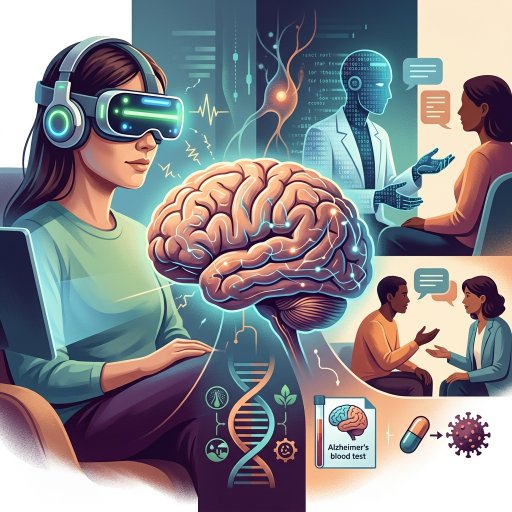
Mind Over Medicine: The Tech Revolution Reshaping Mental Health
The FDA just cleared a $600 headset for PTSD—while the VA’s MDMA trial, the one that might actually work for the hardest cases, won’t read out until 2030. The gap between the sales pitch and the science has never been wider.
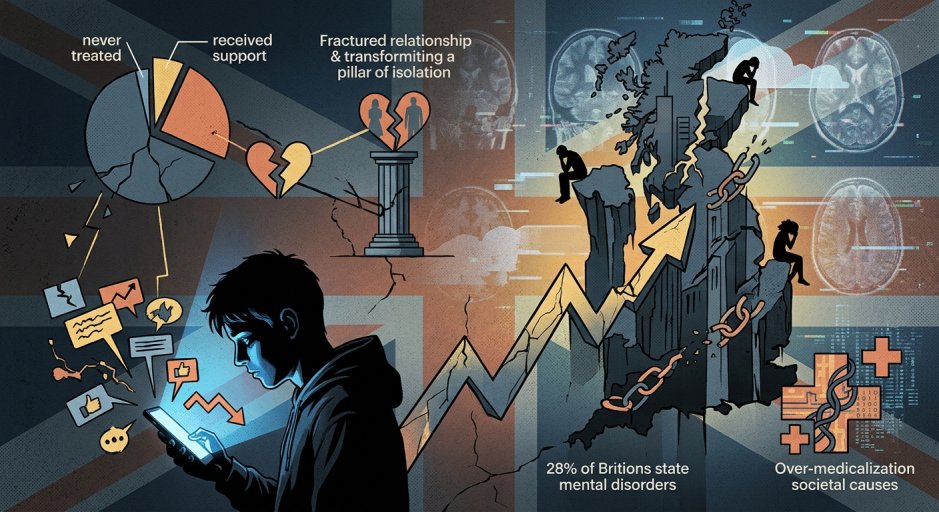
The Unseen Crisis
It is now statistically normal for a young person seeking mental health information online to report frequent thoughts of suicide. The data is unambiguous.
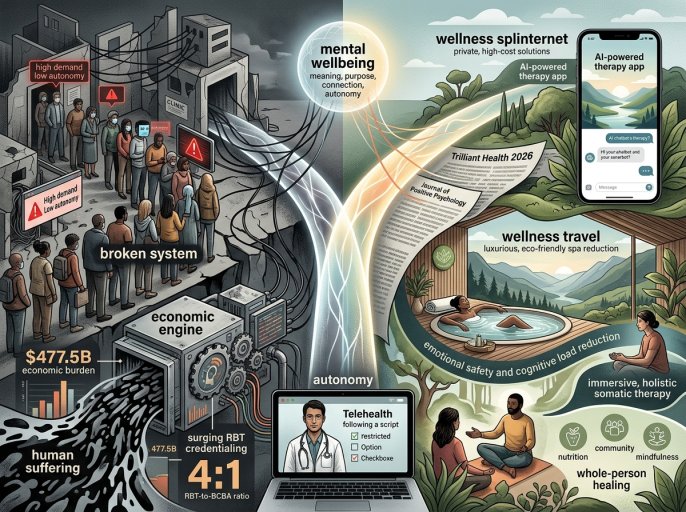
Redefining Mental Wellness
The United States is experiencing a historic behavioral health crisis—and the systems built to address it are being reshaped, not by clinical need, but by economic incentives, technological band-aids, and the logic of consumer markets.